|
1. "Enterprise" overview - facts, figures, files
|
General facts
 |
 |
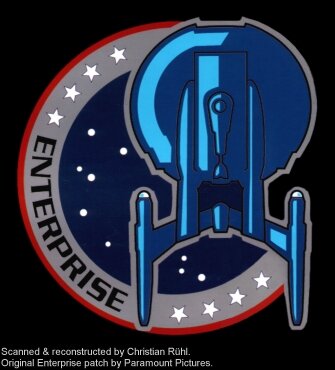
| Click on the thumbnail for a larger version of the patch scanned and partly reconstructed by the . If you want to use it, please do not forget proper credits and a link to the Star Trek Dimension. |
| |
| Title |
Enterprise, inofficially abbreviated "ENT" |
| Note |
Fifth Star Trek series, forth successor to "The Original Series" |
| Tagline |
"Back to where it all began" (originally "The final frontier has a new beginning") |
| First presented |
on May 10th, 2001 |
| Premiere US |
Sept 26th, 2001, 8pm on UPN with two-hour pilot episode "Broken Bow" |
| Premiere UK |
Jan 7th, 2002 on Sky One |
| Premiere Germany |
Sept 13th, 2002 on SAT.1 |
|
|
| Creators |
Rick Berman and Brannon Braga |
| Executive Producers |
Rick Berman and Brannon Braga |
| Directors |
James L. Conway (1x01, 1x02), Michael Vejar (1x03, 1x09), David Livingston (1x04), LeVar Burton (1x06), Roxanne Dawson (1x07), Robert Duncan McNeill (1x11), Ben Willcock and others |
| Staff writers (Season 1) |
Rick Berman & Brannon Braga (former executive producers of "Star Trek: Voyager"), Michael Sussman & Phyllis Strong (former "Voyager" writers), & André Bormanis (science consultant of TNG, DS9 and VOY plus former "Voyager" writer), Maria & Andre Jacquemetton (writers from "Relic Hunter", "Highlander: The Raven" etc.), Time Finch & Stephen Beck (former "Seven Days" writers), Antoinette Stella (former co-producer of "Melrose Place") and Fred Dekker |
| Regulars |
Scott Bakula, Jolene Blalock, John Billingsley and others |
|
|
 |
You will find a complete overview on the production and writing crew in the Internet Movie Database. |
|
Look up all up to now produced episodes, including a short summary, in the Enterprise Guide of this website. |
The setting
| Time |
2151, exactly 150 years after our times, 105 years before TOS season 1 and 226 years before VOY season 7. |
| Place |
The Earth Starfleet vessel Enterprise, NX-01, travelling in our backyard, i.e. the solar system and adjacent sectors, as well as exploring "the unknown". |
The title sequence
Already when you see and hear the title sequence shown in every episode after the teaser, you will realize that this series is a bit different than its predecessors: you don't see the classic flight of the series starship before a star background, but a historical summary of humanity's dreams of exploration (first regarding the own planet, finally regarding space) that have become reality. Of course, the focus are the ships with the name Enterprise. A sequence of dynamic images shows the real development - from the first sailing ships over the first space probes and the era of manned space travel to the current construction of the international space station (ISS) - followed by the fictitious Star Trek chronology - with the first warp ship, the Phoenix as seen in "Star Trek: First Contact", and finally, the "new" Enterprise NX-01.
The music of the scene is unconventional as well - at least for Star Trek. Instead of a classic-instrumental cue we have a contemporary soft rock song called "Faith of the Heart", performed by English opera tenor Russell Watson. Even if the melody may be difficult to accept for some, the lyrics fit incredibly well the mission of Enterprise (both the series and the ship), as the following, exact reproduction shows:
It's been a long road
Getting from there to here.
It's been a long time
but my time is finally near.
And I will see my dreams come alive at last
I would touch the sky.
and they're not gonna hold me down no more
no they're not gonna change my mind.
(CHOR)
Cause I've got faith of the heart,
going where my heart will take me
I've got faith to believe.
I can do anything.
Ive got strength of the soul,
No one's gonna bend of break me
I can reach any star.
I've got (4x), I've got faith - faith of the heart.
|
|
|
The new album "Encore" by Russell Watson containing the CD version of "Faith of the Heart" in full quality and many other exciting tracks can be purchased here at Amazon UK. |
Frequently asked questions
Why not "Star Trek: Enterprise", but simply "Enterprise"?
According to series creator Rick Berman, "Star Trek" was left out to mark the difference to the last 3 Star Trek series (TNG, DS9, VOY), which all carried the two famous words as they were clearly some sort of direct "successors" to "Star Trek" (The Original Series). "Enterprise", on the other hand, is a prequel to TOS which has (or is at least intended to have) nothing to do with its later reincarnations and should therefore carry a unique title as well. Furthermore, "Enterprise" implies Star Trek anyway, as it is almost a synonyme (definitely in Germany ;-).
|
If you have additional general questions on "Enterprise", please drop me a . |
|



 (RA G2, 1:00 min, 0.73 MB)