|
|
|
||||||||||
|
Welcome, Star Trek fans and Sci Fi freaks, chronologists of the future and misguided Babylon 5 enthusiasts, to "The Star Trek journey", the weekly column of Christian Rühl on Star Trek, the fandom and the internet! Having gained net access 24 hours a day, 7 days a week (well, theoretically), I can't resist to take the great opportunity to submit my two cents on the most recent, most important events regarding Star Trek - every week. Past headlines and updates, current rumors and episode spoilers and my own projections for the future... you all find it here, so please move out if you don't want to know anything about the upcoming events! And be warned: this is not a news coverage - it's pure, subjective, more-or-less-accurate speculation... Everything here is written from my point of view. If you don't mind, then, dear fellow travellers... fasten your seatbelts, join my personal trek to the stars and enjoy the ride!
This is a special version of "The Star Trek Journey", which does not follow the established format. Engage...
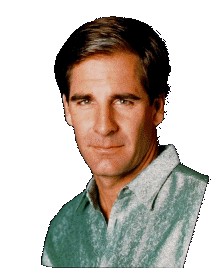
Officially announced: Enterprise It's been a long, long time since I wrote the last "Star Trek Journey", but the break was necessary. For me, the Endgame situation was escalating, since (sadly) most of the rumors turned out to be true, so (just as I announced some issues ago) I didn't want to speculate on this anymore, but just watch the final product on May 23rd, with the hope that the actors, the pacing and the effects could rescue this finale for which I don't have very high expectations any more. We couldn't be certain - until last Friday, when it finally happened, the Major Star Trek EventTM. Already the day before, late on May 10th (EST), all big internet entertainment news sites had covertly posted the official Paramount announcement. Interestingly, I wouldn't actually have known of this groundbreaking development for three days if I hadn't turn on my computer for a short peek in the message boards on Friday morning. Was it a gut feeling? Maybe. Good instinct? One never knows. Trek obsession? Definitely. Quite surprised, but also annoyed (I wouldn't take part in the "aftermath" of one of the most important Star Trek events for several days!) of the confirmation of an old rule (important things happen in the most unfavorable moment, of course...), I decided to write at least a short note for the German Star Trek Dimension. Consequently, at half past eight (CET), my website was one of first to react on the announcement, before all other German news sites. Enough self-praise, back to the topic ;-) Well, the news were, actually, no news to me, as they weren't for most trekkers who regularly use the modern means of communication. The official announcement of the fifth series, "Enterprise", its lead actor, Scott Bakula, playing Captain Jonathan (a slight change from "Jackson") Archer, the other characters and yesterday finally the 22nd century setting (with the last minute-surprise that the series will play early in this century, mere one hundred years after present), was more of a confirmation of all the rumors, semi-official comments of actors and insider news. All these rumored aspects we now consider as official facts have been emerging for two and a half months. Yes, I still remember I evaluated these "insider" information with attitudes from ridicule to absolute denial in my first four columns. I mocked at the "nicely faked" casting sheet (issue 1), boldly promoted not to make the series "Star Trek: White Male American" (issue 2) and even made Scott Bakula my personal April Fool's joke (issue 4). As time went on, and we got more and more hints the one or the other speculation could be true, I began to accept that the probability of a series as depicted by the rumors might be not as low as I thought. - This is the 21st century, or third millennium, since suddenly everything what looks true is actually true. Where are the good ol' false rumors (that really deserve that designation), the misinformations, the obvious fallacies? - Rumors (and not only rumors) travel at warp 10 in the internet. They emerge from one moment to the other and are everywhere at once. And sometimes, it seems as if they are present before we actually realize it. Talk about time travel... - The safety measures of Paramount are ridiculous. Actually, we should have been warned that there are obvious leaks that present critical information on new movies and series very early ever since the complete Star Trek: Insurrection plot was published in March 1998 (nine months before the premiere). No one knows it? The rumor hasn't reached the internet yet? Forget it, TPTB. - I shouldn't dismiss potential facts prematurely, no matter how ludicrous they look (and how much I dislike them *sniff*). And I should have learned this lesson since the unbelievable "Nazis in space" spoiler turned into an actual two-parter... Yes, that's "suspense of disbelief" in a different sense... Not even a week after the official announcement, these points have been verified by a whole bunch of new rumors, sorry, potential facts concerning series V details. We know the full cast and what role everyone will play, we got information on the uniform design, character name changes and even the current pilot title. I don't even try to doubt these "facts". Even if they are wrong, what does it matter? They are mere details of a picture whose basic motive we, finally, know for sure.
Big chances, bigger risks: Enterprise
First, let me say that I don't think a prequel series is necessarily a bad thing (actually I prefer The Phantom Menace over all other Star Wars movies, but, that's another universe...). To my mind, the 22nd century premise has quite a lot of potential. The 24th century Star Trek series TNG and Voyager, and, to a much lesser extent, the Original Series and Deep Space Nine, showed us an idealized, utopian future, where humanity has defeated poverty, crime and war, where nearly perfect, matured, reasonable and extremely cunning humans live and work to improve their own lives and mankind itself. With doing this, Star Trek was a really unique kind of science fiction, since shows of that genre usually show us dark, pessimistic futures (reflecting the anxiety and fatalism of people at the beginning of the 21st century). Star Trek's vision was and has always been one of hope and confidence, carrying a message that encourages the people, gives them hope and makes them wishing they would live there. Now, this concept just can't be altered, even after four Star Trek series, but a new point of view was needed. As you might know, I don't think the true core of Star Trek, the idea behind it, is restricted to a special future (it's "psychologic science fiction" detached from the classic futuristic elements), or even a future at all. To my mind, the said vision is universal and applicable to any setting (proven by Voyager's "11:59", a Star Trek-like story playing in our very present!). As long as the spirit of Enlightenment and Humanism is kept, it's irrelevant where and when the voyages take place. "Star Trek: Enterprise", for the first time, now plays at a significantly different, much earlier point of the Trek time line, and might provide the needed fresh view. So, my problem with "Star Trek: Enterprise" is not the intended idea or premise (which has already been hinted in the casting sheet and the pilot review), but the actual realization of this mere framework of thoughts. A prequel series in general, and especially a Star Trek series which precedes 9 feature films and over 600 episodes from four other series, requires a lot of responsibility, reason, persistence and, by all means, in-depth knowledge of the established background. First, are the writers really willing not to contradict, but to keep up the established continuity of the Trek timeline, and the basics of the Star Trek universe in 170+ episodes of prequel Trek? Moreover, do they really intend to restrict the crew's knowledge of the universe in general and treknology in particular? Everything is (relatively) new to mankind in the 22nd century: the outer regions of space, the alien races, the fantastic new technology. And, most important: many of these things are even unknown for them, given that they haven't been discovered or invented at that time, or were even new in the future. I'm speaking of technologies like holodecks, replicators and phasers, most of the Alpha Quadrant and regions of space farther away than some dozens of light years regarding galactic cartography and such species as the Ferengi, the Borg and the Trill. Additionally, most of the unsolvable situations most be exactly that for the Enterprise crew: unsolvable. Deus ex machina and technobabble solution is a no-no, they just can't pull a new miraculous particle or an obscure new technology out of their hat to save the day. They've done that in the past, sure, but for once, consequences are important. For example, Voyager, as well as it kept the Roddenberry vision, pretty much damaged the coherence of the Star Trek universe, its science and chronology. By constantly devising new weapons, propulsion and communications technologies which finally made them even able to outgun the Borg, to travel tens of thousands of light years within days and to establish transgalactic two-way realtime contact, the series made it very difficult to think of any near future where the Federation wouldn't be a galactic superpower. While this development is undesirable, but still not implausible, the difference with Enterprise is that the series already has an established future. And while it is a wanted option for the other series, the stories of a prequel series have to adapt and subordinate to the premise of the series and the entire background of the Star Trek universe, and not vice versa. It is a strict requirement to ensure credibility and inter-series continuity (while the inter-episode continuity, though not liked, might be as restricted as TNG's or VOY's given the classic, episodic television format preferred by TPTB). However, we all know that Voyager's writers all too often did not stick to that formula but altered character consistency, continuity and Trek technology at will to fit the intended stories. It wasn't because of their lack of knowledge. It was pure ignorance and the general desire to "play safe", to satisfy all (casual) viewers, and therefore don't take any risks in favor of nice "p.c." solutions. Sometimes, it was a downright insult to the intelligence of the real fans. You now might understand my fears for "Enterprise" if you reconsider who the creators and executive producers of the new series are... Secondly, the Star Trek vision itself, and everything what Star Trek originally meant to the audience, is in danger. The Star Trek universe of the 22nd century and its social and political standards just give the writers the convience in thinking they are usually striving for so intensively. Summarized, if they aren't careful, not much of the "psychological science ficiton" will be left. That was one of the points why The Original Series was so unique, so groundbreaking, and kept its viewers for such a long time. However, starting with Star Trek: Deep Space Nine, Star Trek has somehow lost its social foresightedness, but seems more like a contemporary mirror. It is somehow remarkable that both post-TNG series, as different as they were, both represented high quality televison and Star Trek by all means, but both considerably damaged the saga. Given the early 22nd century premise and the resulting consequences for the Star Trek background, there are similiar risks for "Enterprise", especially if they bring in too many new writers unexperienced with Star Trek. Furthermore, there is no Federation in the new series, and no Starfleet. Hence, the Prime Directive hasn't become valid yet (what is understandable in light of the lack of experience with alien cultures), and it is very doubtful if the Earth organization the Enterprise belongs to (UESPA or Earth forces) has a primarily scientific assignment as well.
The third danger, and it might be the most imminent of all, appears odd in light of the mentioned (perhaps too much) difference of the new series. It is the risk that the new series will be only a lame re-hash of one of its predecessors, or, more likely, a colorful mix of well-known elements of all series. To boldly go where many have gone before...
And: while Rick Berman announced the series itself would be "revolutionary new" and "taking Star Trek to the 21st century", something that is somehow not backed up by the announced cast, he also said that he would bring in "fresh blood" behind the scenes as well. However, up to now I've only read well-known names on the production crew list. If even the writing team is the same old one, our only hope of some difference in the look & feel of the show may be the creative concessions made to Archer actor Scott Bakula. So setting off the chances against the risks, I must say the dangers really outweigh the opportunities. Now, at the beginning, everbody - including the producers and writers - naturally is very excited and enthusiastic about the show. They surely want to make it different and refreshing, but maintain the Star Trek values that make the saga so special by all means. They want this series to show "history", to actually show the development that, as a consequence, lead to the interstellar alliance known as "Federation", but will they really keep this premise and made their stories live up to it for seven years? Let's hope it - the future has just begun.
Christian Rühl Webmaster - Star Trek Dimension
|
||||||||||
© 1999-2001 by Star Trek Dimension / . Last update: May 18th, 2001