"Enterprise" - this is the word most often used in Trek fandom at the moment. No matter if loved or loathed, the new Star Trek series carrying this title (implying Star Trek but not actually containing the famous words) is currently discussed to death by the fans in newsgroups, message boards, e-mails, and it is prominently featured in television and newspapers, presented by the producers to critics, journalists and of course the future audience.
In the course of the last months, since the official presentation of the series in early May, we've heard and seen a lot about the next Trek reincarnation - the creators, actors and members of the production crew have been quite talkative. Needless to say, the "inofficial channels" (spys, insiders, undercover Paramount officials (?)) have provided us with everything we've yearned for in the first few months of the year - mostly detailed information on the pilot, but also interesting background facts -, but, more important, all these things have been more or less confirmed in the meantime. |
The official Enterprise logo, from the UPN teaser promo
|
Quite a lot of time has passed since my last two "mammoth" articles in late May, dealing with a birth and a death in the Star Trek franchise: the introduction of Enterprise with the first official words ("Enterprise - Quo Vadis?") and the end of Voyager with the airing of the series finale ("Journey's End"). As I outlined, much has happened since then, but - just like with Voyager's "Endgame", I felt it was necessary to reserve my judgment until I'd have some more "meat" (official material) to back up my views and feelings concerning the new series (or, as the pessimist in me would say, until I could see something positive concerning the series).
So were do we stand now, in late July, two months before the Enterprise pilot finally airs? We still ask and wonder: "Enterprise - quo vadis?" That's only naturally.
When "Star Trek: Voyager" final episode had aired, not only the forth Star Trek series had ended. Given what we know now and knew then about the Voyager successor, at once, it was the end of the Star Trek we've watched, absorbed, discussed, probably even lived for 14 years. Call it the "24th century Trek", call it "second generation Trek", it doesn't matter, but it is a fact that we now experience a condition very similiar to the situation before the launch of "Star Trek: The Next Generation" in 1987, when the TOS fans had to deal with this new type of Star Trek, which wasn't "exclusively made for them" and wasn't an "TOS addition".
In fact, I tend to believe that the new series is intended to appeal to a new (contemporary) generation of fans as well, or, to introduce a much broader audience to science fiction in general and Star Trek in specific, as the last two Star Trek series haven't been the huge general success TNG has been.
This new series isn't just the next "spin off", set in the same century, with a similiar background and similiar stories dealing with similiar aspects, made for the same group of fans.
In a way, the last two series were only "supplementals" to "The Next Generation". This is not meant negatively, but Rick Berman may be right when he states it's time for a change. Of course, no one likes changes. "Change means exactly that happens what you didn't want at all" is one of my favorite quotes, and, if we are honest, trekkers are the most rigid people out there.
So, just like in 1987, there is of course a lot of excitement and anticipation, but also anger, despair and fear involved in the discussions of the trekkers who suddenly don't know what will come. They are insecure and ask "Will this new series still be Star Trek?". "Will it dumb down Trek in favor of sex and action?". "Will they throw everything what has been established in the last 14 years out of the next airlock?"
"Poetic justice" may be a thought of some first generation trekkers, the first hour TOS fans, who had similiar problems accepting the "new generation" of Star Trek which "changed way too much to be still Star Trek and shamelessly plagiarized from the one and only Trek at once". The shift from the 23rd to the 24th century, from the often "quick and dirty", but highly ambitious TOS universe to the more relaxed and "stylish", but also less passionate (some would say "sterile") TNG universe, from the views of the sixties to the views of the eighties and ninetees caused a permanent schism in fandom. Generation conflict. It's that simple and difficult at once. We currently have two generations of trekkers, each of which has grown up in different, maybe incompatible times, and had their first Trek experience with different series. Of course, there are already fans which were "recruited" as trekkers by "Deep Space Nine" and "Voyager", and your first Trek series is most often your favorite series, but as I said, the differences aren't that large between TNG, VOY and DS9 than between "Next Generation Trek" and "Classic Trek".
Now, 14 years after the launch of the "Next Generation", there is another, a similiar shift. And again, you can't just say it's a mere shift of settings (from the 24th to the 22nd century).
"This won't be your grandfather's Star Trek" and "everything fresh and new" in contrast to "back to where it all began", Berman's conceptual cornerstones for the new series, illustrate the situation quite well, and I would hypothesize the following:
| "Enterprise" will recapture the original (emotional) essence of Star Trek, the reason why millions of people grew fond of the show in the late sixties and seventies - the sense of wonder, the awe, the excitement and romantic hopes concerning the exploration of space, the approach and advancement of the new frontier which John F. Kennedy set in the early sixties, and, in a more general sense, the advancement of the human knowledge, the human experience, the human spirit itself, while the producers will avoid as much as it is possible to remake "Next Generation Trek" and "Classic Trek" as well, trying to give the series an own, quite different and modern look. And after a time of serious pessimism concerning "Enterprise", the recently published promo teaser with the very first footage of the series (which, yes I admit it, was so good that it turned my frustration into a - let's call it restrained enthusiasm) gives hope that we might actually see this. |
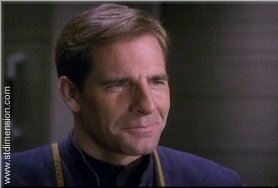
Scott Bakula ("Captain Archer") has a almost childish look of expectation when he orders "Let's go!" in the "Enterprise" pilot "Broken Bow" (picture from the UPN teaser promo)
|
To learn to live in peace in harmony, to strive for equality and tolerance, to work hard for a better world - that were the enthusiastic, idealistic, often unrealistic goals in the first years of Trek, and that was something "Classic Trek" incorporated much more than "Next Generation Trek".
The latter one has shown the final goal of human development, a perfect, utopian place where pretty much everything has been learned and discovered (which has been very impressively shown with Voyager's series finale and its outcome, as I pointed out in the last issue). A static place reflecting the absolutely not passionate and daring, but unspectacular and conservative nineties just as TOS reflected the sixties, some might say. As much as I love "my" generation of Trek, I must admit: there really isn't much sense of wonder anymore - neither for the characters nor for the audience -, since everything in every combination has already been experienced - in the fictitious Star Trek universe and the various Star Trek episodes, respectively.
Consequently, this was the crucial point to be changed for Berman and Braga - the new series will not only go "back to the roots", but even a step further than the Original Series in showing the first steps to this better future (the quote from the eigth feature film concerning the post-First Contact age), the stage of development. As much as I love Roddenberry's utopian view, I strongly believe this fresh, dynamic approach to Trek could be exciting and inspiring as well. "Star Trek" literally implies that there is some sort of movement out there, an expansion or advancement, and while the last two series restricted this somehow - "Deep Space Nine" with the static space station setting (which was tried to make dynamic with the changes in condition, the political changes) and "Voyager" with the "lost in space travelling back home" premise (Braga recently admitted in an interview that sometimes he had wished Voyager would have been the classic "trek to the stars", thus ignoring the impact of the premise on the stories) -, "Enterprise" may pursue this principle not only with the classic "to boldly go there no one has gone before" starship trek, but also with the general and personal development of mankind and the characters, respectively.
The reevaluation of mankind's place in the cosmos, and the consequential impact on the individual lives, the development and growth to the better, the solving and overcoming of Earth-bound problems (hunger, poverty, crime) in order to explore space as a united human race, the peaceful working together with other species - these are things I expect to see in a post-First Contact and pre-Federation series, these are things I want to see evolve in the course of this fifth Star Trek series.
As a show about humans exploring space for the first time in a not too distant future, "Enterprise" will probably pretty much reflect our own hypothetical reaction, if we could see these things with our own eyes (and since venturing to space is particularly an American dream, this may explain why not only most "Enterprise" crew members are humans, but why most humans are Americans). The "realness" of this depiction of hope and fear, awe and trepidation to the audience could be a decisive factor for a broad success of the show.
And if they at once maintain the confidence, the idealism and optimism in the future that is so different from what we usually see in science fiction (as Berman likes to point out quite frequently), this positive attitude that is - emotionally and rationally - such a great inspiriation for many, I think I will be very pleased with "Enterprise", despite the various already known and surely still emerging Trek continuity and science problems, as the philosophy behind Star Trek, the issues and ideas it stands for - have always been more important to me than starships and technology (as much as I like to deal with that).
While the producers probably wanted to recapture the essence of Star Trek with "Enterprise", they necessarily had to bring Star Trek to the 21st century (as Berman once put it), to modernize it and make it look "cool" in some aspects in order to appeal to and "recruit" this new audience.
I have no problem with this change of the exterior appearance, as long as they keep the interior values which define Trek.
However, of course this goal almost certainly had to lead to a conflict with the prequel premise, which would require a more simplified look in terms of Star Trek chronology, and a even more primitive appearance in terms of Trek production history.
As the producers have pointed out, they tried to find a golden path, but as we know from the various revelations (the "Akira-prise" comes to mind), they actually decided to pursue their initial goal without greater compromises more often.
Of course this slap in the face of many long term fans and continuity or Trek science buffs is very sad (I'm convinced that with some hard work, there could always be way to respect Star Trek history, create a clear "retro-look" and still produce a cool-looking design), but there's really nothing we can do about it but accept it as "contemporary artistic freedom" - or declare the series "non-canon", but this has to be decided after actually seeing it; every other approach would be a premature overreaction.
|
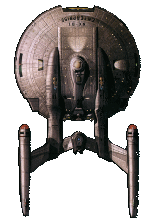
The Akira-prise: object of displeasure and outrage
|
I believe that the future depicted in Trek, with its inclusion of psychological factors, "social progress" beside the technological and scientific development, is the most realistic (and most desirable) in 20th century science fiction, but, as pointed out, in terms of both visual design, general tone and promoted ideals Star Trek has always been a "victim of its time", featuring a very contemporary approach of submitting its message.
"Enterprise" might become a successful series as long as it can appeal to people, as long as the audience can imagine, identify with or desire this future, and it might become a successful Trek (in my opinion) if it meets the given "special criterias" for a post-First Contact series. However, while it's really difficult to say what our times (the early 21st century) define - after the sixties, seventies, eighties and ninetees, we don't even have a name for this period - "Enterprise" undoubtedly will become a contemporary product.
But whether it will have the timeless influence and everlasting charme that has made both TOS and TNG immortal, we'll only see in a few years, when we look back to this interesting time of changes.
Christian Rühl
Webmaster - Star Trek Dimension
 |
Read everything on "Enterprise" - general facts on the show, the rumor history, complete and up-to-date information on the cast and the first episode, impressive images of the NX-01 and high quality pictures from the pilot in the now avaiable special project "The Enterprise Companion"! |
|