|
|
"Broken Bow - A new beginning" Comment, review and analysis on the "Enterprise" pilot October 3rd, 2001 |
||||||||||||||||||||
|
Welcome to this very special article extensively dealing with the "Enterprise" premiere on Sept 26th, 2001. You will find out that this article consists, beside the preface, of three big parts - a comment dealing with the "Star Trek" value of "Broken Bow" in specific and "Enterprise" in general, an in-depth analysis of the two-parter, concentrating on the central themes and main conflict, and a comprehensive assessment, including a comparison to the other pilots, a look at all characters and their depiction in the pilot and more! Don't forget: this isn't a "Broken Bow" summary, yet you will nevertheless find extensive spoilers. That said, I hope you enjoy my take on the "Enterprise" series premiere!
Ever since I heard this final dialogue at the end of the 1996 feature film "Star Trek: First Contact", which showed both humanity's first leap to the stars with the maiden voyage of Zefram Cochrane's warp ship and our first contact with an alien species - the Vulcans, I was curious and fascinated to learn more about these "first steps". The actual First Contact marked the end of the eigth Star Trek movie, but it was obvious that this most important event in human history would only be the beginning of a long development which would unite mankind in a way not believed possible, give them the inspiration and strength to fight and surpass the milleniae old evils of hunger, war and disease, make them reaching for the stars and establish themselves as worthy members of the interstellar community, and eventually lead to the foundation of an interstellar Federation, which was the basis for all Trek Series up to now. Therefore, ever since I learned that the next Star Trek series might deal with these very beginnings of "the" Star Trek in the first months of this year, that this series might go return to a time even before The Original Series and show the first real deep space exploration in the 22nd century, a time when travelling a hundred times faster than the speed of light, exploring strange new worlds and making contact with alien species was not "business as usual" and the maturation of mankind itself was - like its technology - still "in its infancy" , I was very excited over the opportunities of this new approach on Trek. I absolutely loved the Trek represented by the first four series, and wouldn't have minded dozens of additional seasons in the 23rd or 24th century. But seeing the "creative burn-out" of TPTB that became visible in different ways in both DS9 and Voyager, in the one by a definite lack of Trek vision and the other by a lack of technically good story telling, I would've strongly voted for a break for some years after the Voyager series finale, "Endgame". I would have, if I hadn't known of "Enterprise", the series whose mission is "to go back to the roots" concerning the Star Trek universe as well as the real world, recapturing the original Trek feeling while keeping the proven Trek philsophy, the vision of the world that makes Star Trek so unique among science fiction. If you are a great Star Trek fan for many years, a overwhelming excitement over the launch of a new series is certainly normal. And actually it was only the second time I experienced this mixture of hope and enthusiasm. "Star Trek: The Next Generation" made me a fan in the early nineties, but actually "Voyager" was the first series I watched from the beginning to the end as an experienced Trekker, as somebody who knew what he'd like to see in Trek and what not, what Trek defines and what not. Therefore, last Thursday, when I got the chance to watch the "Enterprise" pilot for the first time, was certainly not less thrilling than June 22nd, 1996, when the forth Trek series aired for the first time in Germany (at that time I actually had to wait for over a year to watch new episodes!), although nowadays the internet with its far-reaching spoilers and insider rumors certainly takes away a bit of the fun. I knew hell a lot about "Enterprise" when it started - about the ship, the crew, the technology, and the first mission - but because (or perhaps despite) of this, I had some serious reservations. If I'm honest, not so much regarding continuity, but, in light of TPTB's goal to appeal to a new group of fans with this new series, to make it "not your father's Trek" by abandoning the "stodgy" parts, to "recapture" or even "re-invent" Star Trek, omitting the "Star Trek" brand name as a possible attempt to create a whole new franchise only losely based on the saga we love so much, rather regarding the essential question:
Of course, the immediate counter question is "What is Star Trek?". As there are so many reasons why different people of different nationalities, age groups, educational degree and basically, motivations, watch Trek, you might ask as well what the true religion is. No matter what the answer is, the question is crucial for the acceptance new Trek series, as certain fears regarding "Enterprise" are based on certain motivations to watch Trek. Some watch for good stories and characterization - and while I think this definition is rather pointless as it can be applied to any dramatic TV series, "Enterprise" has as much a chance to fail or succeed in this regard as any of its predecessors. Some say that Trek must be about the distant future with superior technology. As "Enterprise" explores the past of the future (so to speak) and features - in view of the literally unrestricted possibilities shown in the last Trek series -, rather limited technology (of course, in view of reality, this series is still set 150 years in the future, with a technical level still vastly superior to ours), they may not enjoy the new series. The same goes for people who are only interested in technically perfect storytelling and consistency within the fictitious Trek universe. But - these aren't reasons for me to watch Trek, nor, to my understanding, were it reasons for the current heads of the Trek franchise or Gene Roddenberry himself to create it. As I said, to me Star Trek becomes really unique, really different from other science fiction (leading to the standpoint that Trek may represent its own genre) because of its vision of the future - a future which is not defined by its distance from our times (actually, in the world of science fiction this "future" could be today or tomorrow) or its level of technology, but by its view of the world and the people who are living in it. How many TV series are there who have their own philosophy? In my opinion this system of beliefs - if you want to analyze it scientifically, with its cornerstones meliorism (the belief in a better future and the betterment of ourselves, emphasizing the best sides of humanity), a special form of humanism (the focus on our own kind, its views and needs, and the strong belief in its unconditioned triumph free from heteronomy, i.e. without exterior influence) and the belief in the value of the individual lifeform, and its liberal rights - is and has always been the basis of any Trek. Thus, at least the pilot of the new series seems to verify my view that the "exterior shell" might have been "renovated", yet the inner values are as intact as possible in order to remain overall consistency in this new setting of the 22nd century. Star Trek still boldly goes where no man has gone before in both literal and figurative meaning, it still explores strange new worlds of the universe and the human condition, it still advances the final frontier of space and our basic understanding. Humanity is still the center of this show - no, to be honest, it is more the center than ever before. If you don't believe it, just take a look at the lyrics of the (for Trek incredibly revolutionary, if not blasphemic, judging from the negative reactions of so many fans!) soft rock main theme - It's been a long road, getting from there to here. Cause I've got faith of the heart, going where my heart will take me. These ambiguous words, which amazingly weren't written for Trek, fit both the above described philosophy and the mission of the new series, as promoted by the creators Berman & Braga, quite well, emphasizing the challenge of and excitement for developing, exploring and realizing the own dreams independently. And to my mind, the pilot, as the literal beginning of the future, visualizes this mission perfectly, which per se advances our view of the basic Trek vision as it introduces a dynamic component which simply wasn't possible in the previous Trek series, as they were bound to the properties of the world and humanity of the 24th century, having told their stories in this "static stage". This was always interesting and intrigiguing for us viewers, but the creative minds behind it couldn't continue endlessly but had to change something. The change in the later seasons of Deep Space Nine didn't work for me as it was, in the end, often inconsistent with the maintained 24th century setting and the Trek philosophy on the whole. "Enterprise", however, explores the 22nd century for the first time, where not only the technology, but also humanity itself is in a stage of development. I'm almost inclined to say that this "new" humanity is more alien (yet not less likeable) to the experienced viewer of TNG and VOY than the Klingons (who are still the aggressive warrior race, though they appear to be a bit more primitive in contrast to the 24th century). Of course, with this reintroduction of fallible, erratious, yet striving and adaptive human beings we have to say good-bye to the view of the human approach as the always unbiased, always correct truth it was in TNG and parts of DS9 and VOY. This show is different also in that respect that were probably won't be many stories showing an enlightened crew dealing with alien cultures, exploring their mistakes and teaching them lessons. This time, we can be wrong as well, and while humanity upholds their own approach and moral beliefs out there, there's still "a lot to be learned" (as Dr. Phlox puts it early in "Broken Bow"). At any rate, it seems as "Enterprise" is much more about humanity itself than about aliens, focusing more than ever on the human experience of being out there - not only what to think, but what to feel if we would encounter alien worlds and alien life-forms; the full spectrum from a sense of wonder and excitement to awe and trepidation. This makes this Trek maybe less rational and secular humanistic in the strict definition of the term (ruling out any faith, even if it's faith in the own abilities and success without help from outside), but certainly more comprehensible and accessable for the typical 21st century fan. Now, after this rather general depiction of the fresh and yet familiar "Enterprise" approach, as it translates to screen in the pilot, let's take a closer look at the background of "Broken Bow" with an examination of the major philosophical and moral aspects which I've spotted after reading the script and watching the show several times.
Analyzing "Broken Bow" Logic vs. instinct
Improvement, enlightenment, advancement
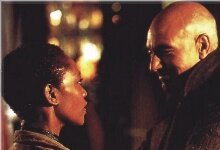
Actually, now that I look back, I remember that after Star Trek: First Contact, after this final scene between Lily and Picard, we pretty much all sensed that the Vulcans were helping us with both our social progress on Earth as well as our progress in terms of deep space exploration; that this First Contact had not only moral and psychological, but also definite material influences. Seeing what Berman and Braga have came up with instead I realize how wrong this notion was. Picard spoke about "first steps into a new frontier", but first and foremost it have to be own steps. What an humanistic approach would it be if humans would have been "sponsored" in that way that the Vulcans had given us the plans for the warp 5 engine and other stuff with the words "Well, here it is"?. Instead, in a very logical move we were experiencing the other side of the Prime Directive, or, to be more precise, a Vulcan version of it, as our "new friends" were not willing to share their vast knowledge with us and instead consistently hold back information. Paternalism or justified care?
Autonomy, on the other hand, is also the key in terms of the Vulcan-human relationship in the 2150s. Of course, the pilot makes it clear that even if we have a lot of the fancy Star Trek technology (even if it is "in its infancy") and an Utopian society on Earth, the human psychology hasn't changed too much yet. "The human instinct is pretty strong - you can't expect us to change over night", as Archer puts it during the dinner discussion, which illustrates the differences between the human and the Vulcan point of view a second time after the initial "clash" at Starfleet Medical. It's not only that the Vulcans have refused to share technology (or provide a social, technological and scientific leap similiar to the one the unknown party from the future has offered to the Suliban) in order to make us act on our own accord instead of allowing us to drift without own impetus. Of course, this would have been sufficient to explain the frustration of humanity (and Archer in specific, in view of the fate of his father, who couldn't see the results of this life long work any more, what is very sad, but quite common if we take a look at the long history of failed human explorers and scientists). Realizing bold dreams
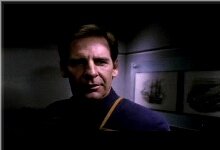
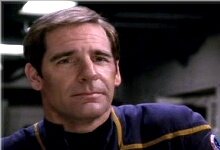
Although "Broken Bow" is an ensemble show as it includes all seven crew members very much in the action and gives them all some strong scenes, the pilot is still first and foremost about Jonathan Archer; about his life and "what he is about" (as Tucker puts it) - his motivations, his dreams, the reasons for his thirst for exploring the unknown reaches of space and meeting alien cultures, and especially his pertinacity to accomplish this first mission of his new ship, the Enterprise, successfully no matter what. I'd like to think, however, that this focus was choosen not only because he's the captain, but because the characteristics and background he's given makes him some sort of a role model or example for the 22nd century human spaceman. While he himself and his friend Tucker explain some of his goals, most of Archer's background we get to know through the above mentioned flashback scenes, a very interesting narrative technique used quite excessively in "Broken Bow", but not without purpose, as they are directly linked to the occuring present events in the pilot as some sort of parallel plot and therefore can be often seen as "real" reminiscences of Archer in the specific situations. Let's take a look. Over the course of the pilot, it becomes very clear that flying this real ship and embarking on real missions into deep space is Archer's life-long dream ever since he started building those models. And so was it his father's dream, who worked with Zefram Cochrane himself on this ship, too, or, more precise, its heart, the warp 5 engine. "Realizing his own dreams" is of course a very American topic, and so it may be the one leaving the most lasting impression of the viewer - especially with those many switches between "the dream" and reality over the course of two hours, and the symmetrical start and ending of the pilot with a flashback scene, emphasizing their importance. Let's see if you can dance
Not only in the flashback scene "Broken Bow" makes use of imagery to illustrate the importance of the launch of the Enterprise and the start of its first mission into deep space. This mission may be simple (at least in the beginning, before things get complicated), but it has a symbolic character that is not only important for Archer and his crew, but - without exaggeration - downright essential for the future of humanity in space. Archer speaks about "standing on our own two feet", Admiral Forrest about "it's finally time to swim" (while has already warned Archer before - "Don't screw this up"). If we look at what Q said in "Q Who" as a part of the very similiar humanity-on-trial storyline of Star Trek: The Next Generation (a comparison of "Broken Bow" with the other pilots will follow later), this fits probably best - "The hall is rented, the orchestra engaged. It's time to see if you can dance." Humanity has waited almost 100 years after the First Contact to get "truly" into deep space and start this ongoing mission Zefram Cochrane spoke about (retrospectively introducing the famous words which have already become a part of Star Trek history with their use in the TOS and TNG opening voice overs). Humanity has worked 30 years to build that new engine, and a ship which can use it and is prepared for the wonders and dangers out there. And now, finally, the Vulcans haven given "their children" a chance to prove that they're ready, that they're worthy to use this powerful new technology and be out there. Failing could very well mean the return to the Solar System, while succeeding could make the Vulcans rethink their assessment of the "juvenile" humans. "Broken Bow", of course, is all about that make-or-break mission, and the twists and turns which make it seem like a futile venture from time to time, though we the viewers are, of course, quite optimistic that the Enterprise crew will eventually succeed. Mission accomplished
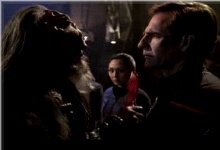
After this climax, the remaining scenes are not surprising and quite self-explanatory - nobody expects any more twists or complications, and thus they return Klaang to his homeworld, where they can present the evidence for the Suliban involvement in Klingon attacks, preventing a civil war. Much has been risked to reach this goal, but only the future can tell the exact outcome of the mission, as the Klingon response on the human involvement is quite ambigious. After all, the Vulcans were charged with returning the corpse of Klaang, but instead the humans took over to take him there alive, though he has already been disgraced by being shot by a "inferior human" and being kept alive by human machines, not to forget that he was abducted from the Archer's ship and held hostage again during the human's mission. That they successfully rescued him might be not that important in the Klingon point of view. Anyway, the chancellor waving his knife in front of Archer and saying something what the captain confidently translates as "Thank you" while Hoshi doesn't want to tell him might not bode well. As we know, Star Trek history described the Klingon first contact as "disastrous" up to now (something what was established in a throwaway line in TNG's "First Contact"), and we do not know if the series creators plan to follow that path in the course of the series. We certainly know, however, that for now, the mission is a success (against all odds), and in view of the importance of the mission for the Vulcan-human relationship I would have not liked a different ending as it had maked the resulting situation completely incredible. As the human approach has - at least this time - payed off and proven fruitful (especially in view of the fact that the Vulcans would have cancelled the mission twice), and Archer and his crew have not only brought back Klaang to the homeworld, but also found out his mission and its background, plus revealed the reasons behind the Suliban's impossible technical and genetical leaps, their contact with an unknown party from the future and involvement in a Temporal Cold War, this time the humans have the chance to take the role of the parent telling the Vulcans what's going on - "It's not every day he gets to be The end is only the beginning
The outcome of this first adventure of the Enterprise crew, of course, is not restricted to some insights for the captain and his Vulcan science offer. When Archer enters the bridge a last time before the end credits and proudly announces "Starfleet thinks that we're ready to begin our mission", these words have far more weight as one would actually think. An old nursery rhyme says "When the bough breaks, the cradle will fall", and their may be a connection to "Broken Bow". The Vulcans have protected, maybe even patronized (as Archer and Tucker think) the humans like children for a century, tried to keep them away from this hostile place called the universe as they felt they were not ready. With the make-or-break return of Klaang to QonoS, however, humanity has proven that they're able to "swim". Now the time has come to give up the safety, but also the paternalism of their former relationship with the Vulcans, in favor of the ability to decide and act for themselves out there in deep space, with all chances and dangers this includes. And while they have still much to learn and experience, they are allowed to carry on with their now starting "real mission" as announced by Zefram Cochrane, the mission Jonathan Archer, and almost every member of his crew, has dreamt of for decades, looking the future that awaits them, they're on the best way to actually become equal partners of their former "caretakers" with maybe different, but equal views, and eventually, at the end of a ten year long road, found an interstellar Federation with them. In all honesty, no Trek pilot could wish an outcome that is more Trek-like, and more coherent with the Great Bird's humanist views of the saga.
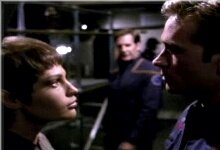
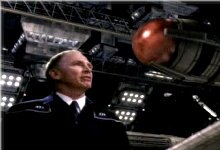
The story After this extensive interpretation of Broken Bow and its various themes, especially the central human-Vulcan relationship, I don't think I have to talk much about the deepness and quality of the script. As so many misunderstood or prematurely dispatched Trek episodes, "Broken Bow" looks like an intellectual light-weight, maybe even a depart from Trek in some cases (if you overestimate the "sexy" scenes, the many action sequences or the "colloquial talk" of the crew members, perhaps), but on closer examination, it turns out to be 100% Star Trek in terms of the multi-layeredness of the story and the (humanist) Trek value of its message. Well, the difference this time may be that it seems that the majority of Trek fans - from all 4 fractions - actually liked it! It seems that this time, Berman and Braga did not only manage to please a lot more people than with either Deep Space Nine or Voyager, but actually managed to put in the best from these two, and the other series. It is clear that a lot of thought went into this pilot, but that is no surprise considering that it is intended to "re-capture" the Trek enthusiasm and bring back the excitement and fun (and thereby a larger audience). Indeed, with its multi-layered story, the interesting characters, the concentration on only a few, yet highly interesting characters (most notably Archer, of course, as the main focus of this story), one epic relationship (the one between Archer and T'Pol, and therefore, between humans and Vulcans, as the central theme of this new series) and one mission, the fast pacing and thrilling action sequences, the impressive atmosphere and the superior production values (after all, the special effects can be considered better than those of the last Star Trek feature film), this initial two parter almost felt like a big screen movie (the 16:9 widescreen black bars had almost fooled me ;-). In short - "Broken Bow" succeeds in presenting a new and fresh approach on the saga while still remaining high quality Trek. But how exactly does the pilot rank in comparison with its predecessors - the pilots of TOS, TNG, DS9 and Voyager? "Broken Bow" and the other pilots A comparison is difficult so early in the run of the new series, as we don't know much about the characters, the relationships, the surroundings and general themes of this new series. To my mind, I pilot can only be assessed objectively with regard to the series it represents (or should represent) - and frankly, though I have a general idea, I just can't say in what exact direction the series will go with the next episodes, let alone seasons. So while I'll definitely say that if we regard "The Cage", "Where No Man Has Gone Before" (TOS), "Encounter at Farpoint" (TNG), "Emissary" (DS9), Caretaker (VOY) and now, Broken Bow (ENT), as stand alone 2 hour "events", the "Enterprise" pilot ranks as high as all other pilot episodes, I will refrain from saying "it's better than this one" or "worse than that one" - simply because they're all excellent, and, if we look closely, while they're all introducing the crew and the setting to audience better or worse, they're all dealing with a specific set of Star Trek typical themes. For example, all pilots dealt in one way or another with "improvement" - no surprise as this was some of the major concerns of the humanist Gene Roddenberry, who created TOS, TNG and, through his "hand-picked" successor Rick Berman, also influenced the later series. In "The Cage", we had species that had evolved so far that they could create real-looking illusions with their thoughts and thereby became unable to have normal lives (the Talosians). "Where No Man Has Gone Before" showed a possible direction human evolution could take with a crew member that developed god-like extra-sensual abilities in that way that he was corrupted by his power and regarded is crew member as inferior "bugs" (Gary Mitchell). "Encounter at Farpoint" featured Q, an omnipotent immaterial being that put humanity on trial because they hadn't improved enough in his opinion to have the "privilege" to be out there. "Emissary" showed Benjamin Sisko first contact with the Bajoran "prophets", alien beings which have evolved beyond the concept of linear time. In "Caretaker", Voyager was pulled into the Delta Quadrant by the Caretaker, a strange alien being with incredible power which took care of the child-like Ocampa, undeliberalely hindering their natural development. As discussed, "Broken Bow" shows "improvement" in many ways, but most notably with the status of the Vulcans, the humans and their relationship. As you have seen another thing all pilots have in common is the first contact with something new; in all but one cases even with a totally new, absolutely different alien species. Interestingly, the "Enterprise" pilot shares different similarities with the three last pilot that go beyond such general aspects. The TNG pilot "Thou art notified that thy kind hath infiltrated the galaxy too far already. Thou art directed to return to thine own solar system immediately" With "Encounter of Farpoint", and basically (as already mentioned) the entire Q story arc of TNG, it shares the basic storyline of humanity having to prove that they're worthy to be out there, and that they have evolved enough to be ready to meet the indefinite diversity of strange new worlds and alien species of the galaxy. The opponent is an alien, more evolved species who is questioning humanity and its "baser instincts", assessing it as "still too primitive". Of course, this conflict is far more pointed in TNG with humanity put on trial by the omnipotent Q, while in "Broken Bow", it's "only" the Vulcans who are trying to keep the humans off from living out their thirst for exploration (depicted as a powerful natural incitement of Man), but still the similiarities are striking. In both cases, space exploration is no matter of course (though this changed in the course of TNG), but a privilege, a right that has to be earned with hard work (in the case of "Enterprise" most definitely). Because of this, they both feature a special feeling with experiencing this privilege - a sense of wonder, awe, excitement. In both cases, the mission of the pilot is essential for the future of humanity, as they probably (and in the case of TNG, most definitely) have to return to their own system if they don't succeed. And comparing "Broken Bow" with the early seasons of TNG in general (indeed, it is amazing how much the new series reflects the "Roddenberry Trek" - and the TNG era as much as the TOS era), it becomes obvious that furthermore the dangers that humanity has to expect play an important role. Deep space is not mankind's original living space, as it is best described in "Q Who" fitting the "Enterprise" setting very well: "If you can't take a little bloody nose, maybe you oughtta go back home and crawl under your bed. It's not safe out here. It's wondrous, with treasures to satiate desires both subtle and gross; but it's not for the timid." The VOY pilot "They're children" - "Children have to grow up. We're explorers too. Most of the species we've encountered have overcome all kinds of adversity without a caretaker. It's the challenge of surviving on their own that helps them to evolve. Maybe your children will do better than you think." For the same reasons the "Enterprise" pilot resembles "Encounter at Farpoint", it shares similarities with "Caretaker", though the storyline in question is by far not as important as in the TNG or ENT pilot. Nevertheless, the Caretaker-Ocampa relationship is a bit like the Vulcan-human relationship, from the way it is described (as a children-parent dependancy) certainly even more than the TNG Q-mankind relationship (especially with regard to Janeway's comment on their right "to evolve on their own", something that is predominantly stressed in "Broken Bow"), though of course the Ocampa are far more child-like than the humans, having neither autonomy nor the willingness to gain autonomy - or advance their understabding and evolve, in this respect. The DS9 pilot With "Emissary", "Broken Bow" has not the mentioned storyline in common, or a storyline at all, but its story structure and main focus. Obviously, the latter one is in both cases the captain, with the pilot, though essentially an ensemble show, predominently dealing with his background, his actions in the present and his character development in the course of the two-parter. Let's take a look: "Emissary" as well as "Broken Bow" begin with a flashback to the past of the respective series captain, where the roots for a current problem for the now grumpy and worried captains lie. Both pilots even return to the flashbacks in the course of the events. The most important similarity, however, is that the present storyline features an important character development of the captains that is linked to the events in the past (this was not the case in the other pilots, in which the captain was introduced but did not grow and used his knowledge and character to solve a problem instead of being influenced by the occuring events), while in the end the two series leads have been considerably changed, are done with the dreary past and are now able to accept the new situation. As mentioned, Captain Archer, however, shares similarities with many of the Trek captains. The characters Captain Archer As described in the "Enterprise" Bible, Captain Archer indeed appears as physical, direct and straightforward in "Broken Bow". As Captain Sisko, he has some serious personal problems, however, due to his personality he has no problems with confronting those (he feels) responsible with that. While in the DS9 pilot, the "clashes" were restricted to one icy encounter between Captain Sisko and Jean-Luc "Locutus" Picard at the beginning of "Emissary" and some quarrels with his new, just as "open-minded" first officer Kira Nerys, Archer appears a lot more grumpy in "Broken Bow" and has some serious confrontations with T'Pol, though their relationship still reminds me somehow of Kira-Sisko, together with their representative character, depicting the relationship between their respective species, and their specific problems (the Federation interfering with Bajor's newly won freedom, and the Vulcan's hindering the human freedom; again, not too different). Archer's way is, of course, considerably determined by the new time setting, in which the humans are not so much different from today and therefore do not refrain from using "colorful metaphors". Perhaps because it is so unconventional for Star Trek, perhaps because their quarrels are really hilarious, anyway I enjoyed his "methods" to tell T'Pol his opinion very much ("Volatile? You have no idea how much I'm restraining myself from knocking you on your ass!"), though sometimes it was a bit overboard ("Now get the hell out there and make yourself useful!"). Thus, it's true he isn't exactly "your Jean-Luc Picard" (as Braga put it once) in terms of his personality, however, his pleasure in exploring space and learning about alien cultures certainly reminds me of Starfleet's finest. And strangely, despite his errors, this guy is likeable. He's human, and he definitely has a place to go. He's already shown the ability to change and grow with his concession at the end of the pilot, and despite his Han Solo (just think of the double gun fight on Rigel X!) / Kirk like approach he's not dumb, as his clever plan to infiltrate the Suliban helix has proven. As I've pointed out before, the latter habit to go the whole hog, even if risking his own life, is very similiar to Kirk's and Janeway's infamous "missions". I bet it won't take him too long to save humanity. Without a doubt I'm looking forward to it ;-) T'Pol I must confess that I originally wasn't too happy with this second "lead" of the series, partly because of its definite resemblance to the standard "Space babe" character introduced with Voyager, complete without emotions and exaggerated physical attributes. Don't get me wrong, I belong to the group who really liked Seven of Nine, thought that she was a great, very complex character and added many interesting relationships and storylines to the series. However, I somehow felt that this new character is just too similiar, and, by the way, I didn't like the blunt way its actress advertised herself long before the launch of the series. My reservations for the actress aside, the character of T'Pol was the biggest surprise for me, as I immediately liked her. Just as I got "into" Archer with the scene at Starfleet Medical, where his refreshing acting against the Vulcans and for humanity (and morals) made him instantly likeable (with his friendly invitation of Dr. Phlox and Hoshi certainly increased this positive feeling very quickly), T'Pol appeared as a thorougly interesting character in this early encounter. She didn't said very much - but the way the actress delivers her lines and makes this character alive is very enjoyable. Early in the game she seems to be inaccessable, mysterious, emotionally cold, with the typical Vulcan stoicism (I'm referring to her quiet, but knowing glance when Archer repeatedly pushes her around), but soon it becomes clear that she's different from the standard Vulcan both Leonard Nimoy and Tim Russ have stamped so impressively. Her emotions surface from time to time - mostly patronizing arrogance ("space is very big, captain" with a very funny eye twinkling she always seems to apply when she wants to express certain adverse feelings without wanting to appear emotional) and annoyed in the beginning ("if there's nothing else"), but later we also discover sympathy (her "yes", when she's been asked by Archer if they have lost the trace) and even a downright positivity towards humans (the final scenes) as she learned a little bit more about these "impulsive carnivores" (just as vice versa). Speaking of the latter, her language is indeed a bit Seven-like, but highly entertaining, and together with Dr. Phlox, who's as a alien a non-native speaker of English as well, it's perhaps the last resort of the clear, accentuated and high-level 24th century speak in the 22nd century. As a part of the central-relationship, she certainly will develop most; as we already know, she might develop a fascination for the human species (what Star Trek series wouldn't be complete without such a character?), and, as the first Vulcan female we're going to see over longer period (the last one I remember was Dr. Selar, which had exactly one major appearance in exactly one TNG episode), which is not as wise and experienced as Spock or Tuvok, she might even have to struggle with her emotions. Interestingly, this would makes T'Pol very similiar to a character who only existed in a series bible and a few unfilmed television scripts - the young Vulcan science officer Xon of the not realized series "Star Trek - Phase II", who had as well problems with understanding the human emotionality - and its advantages at times - and finally tries (in contrast to Spock or Tuvok) to experience emotions himself in order to get along better with his shipmates. Charlie Tucker While the pilot focuses on the Archer-T'Pol relationship and their two characters, 'Trip' nevertheless has the third most important role in the story. He seems to be very similiar in his views to the captain, so that it doesn't surprises that he has - just like him - many scenes with T'Pol were he tries to explain the human point of view to her. Indeed, he is the one who convinces T'Pol twice to carry on and "bend" logic in order to carry on the mission and return to save Archer, respectively. Knowing most about the "Cap'n", he obviously is his confidant; a friend he likes to talk with personally (even if he's a subordinate), a person who he trust 100 per cent. In the planned troika of the series, in best tradition of The Original Series, he will obviously take the part of the emotional guy, though this role didn't become very visible in the pilot, as he and the captain both seemed on the "con" side. It seems that while Archer's sympathy and understanding for T'Pol will grow, he will pretty much remain the guy who questions the "logicians", even though he appeared much more friendly and accessible towards Vulcans than the captain himself, and the classic "Spock-McCoy" quarrels were actually carried out by Archer and T'Pol this time. On the other hand, perhaps they won't copy the TOS relationships completely and thus keep the relative sympathy levels as they currently are. Speaking of McCoy, a similarity he shares with our "country doctor" is certainly the Southern dialect (very difficult to understand for a non-native speaker! ;-), not to forget his charming smile (spot it in the final scene in Archer's ready room). We don't know too much about Tucker's past or his abilities (though his carefulness for his machines would even Scotty let shed a tear), but we will surely find out more in the course of the next episodes. Hoshi Sato Just as T'Pol, the young striking Japanese language expert of the Enterprise, who serves as the ship's comm officer and human translator when the technology fails (and that obviously happens very often!) was a big surprise, and I know she's already a fan favorite. Indeed, she seems to be the most "human" character in that way that she acts a lot like we the viewers would act if we would be out there, confronted with those strange alien places and terrifying alien species. Unlike most of the crew, she didn't ask to be out there, and she's not exactly an explorer (yet), as she mainly left her safe Earth job as an linguistics professor in Brazil for the amazing linguistical challenges she expects aboard this first Earth starship that truly ventures into the unknown (as we know, Archer convinced her with the Klingon language sample). Even if she's not the standard spacewoman (being on leave from Starfleet), she's very enthusiastic about her own field (linguistics) and as excited to learn all those new alien languages as the crew is eager to explore strange new worlds. She's not quite sure if what she's doing is right but actually she's doing a great job. Obviously she's a genius as she grasps the Klingon language from an hallucinating Klaang amazingly fast. As mentioned, she's quite feared by what she encounters, what is extremely refreshing in a Star Trek series, who all are always so downright relaxed and serious about making first contact with an alien and beaming down to a light years away planet. Her comments are witty, down-to-earth and quite unconventional for Star Trek in that respect as well ("You might think about recommending seat belts when we get home." - the first time somebody's suggesting this after 35 years!). She certainly has a complex personality, with lots of human quirks, what makes her extremely likeable, and quite accessible. In some way she's the Ezri Dax of "Enterprise" - and not only because she gets jumpy when the ship accelerates to impossible speeds. Accordingly, a ongoing topic related to her could be "overcoming the own fears and self-doubts". Given her role as translator and perhaps even a confidante of the captain (they seem to know each other very well), she naturally has a fairly big part in the new series (right after Tucker), what will certainly increase her popularity. Dr. Phlox Speaking of quirky personalities, the alien doctor of the NX-01 is a unique human(oid) being. He will certainly become one of the most-loved (and most-hated) characters, as one group will absolutely adore his fresh, almost shockingly positive approach to life in general and his job in particular, while the other group will fear the next appearance of this obvious Holodoc-Neelix mixture. As I liked both of the latter character, you can bet that I already belong to the first group. A very nice, entertaining guy, who, in contrast to his easy-going, not very serious nature, seems to have an amazing intellect and great experience. He's the one reassuring the captain (who's not exactly the most positive guy in the pilot) of his "charming optimismmm", and he's the one who cites Roddenberry philosophy when talking about the advantages of his approach on medicine (with all those strange creatues in sickbay). As I pointed out, he shares some characteristics with the holographic Doctor of Voyager, including his fascination for human activities (Chinese food, in this case, but there will surely be more soon), an almost vocal pronounciation and a acceptance of "natural" medicinal approaches. Though the Doctor would surely be outraged about Phlox' use of leeches... Malcom Reed While the above mentioned character had all their fair share of memorable scenes, the two lower rank guys were a bit underused in the pilot and mainly served as helmsman and armory officer, respectively. It's not that they hadn't some nice scenes (Reed's and Mayweather's first use of the transporter) and strange encounters (meeting the alien butterfly eaters!), but we didn't learn much about their past and personalities. The English armory officer is certainly the biggest mystery in this respect - he has an interesting dialect and an affection for weapons with Scotty-like technical skills (having developed both the "anti maglock device" and the phase pistols), but that's pretty much all we know from the initial two-parter itself. In the end, the lack of knowledge about Reed makes it difficult to feel anything for the character, however, this also gives the upcoming regular episodes a lot of opportunities to define Reed's personality more profoundly, and make us familiar with our resident Englishman. Travis Mayweather The young helmsman is introduced as "the space boomer", and this heritage obviously defines his personality. The other crew member envy him for the knowledge he has about alien worlds and cultures, as he was born on a cargo ship and has visited more planets outside the Solar System then even the captain. A nice scene with him and Tucker at the "sweet spot" of the ship already defines their friendship; Travis is certainly more juvenile than the older Tucker, but yet has more experience in many fields (as we have to learn ;-). Despite his familiarity with space, he's as fascinated to be aboard this ship and on this mission as just as almost everybody else aboard. Travis' personality remains sketchy from the few close encounters we have in the pilot, yet he appears to be a very vivid, likeable guy, someone whom one certainly wants to learn more about in the future. The bad Certainly in every review, even in those who are as long as this one, where come's a point to speak about what wasn't good (given that the episode was received well at first; otherwise, the bad aspects certainly will be dealt with early). If you remember my last in-depth review of the Voyager series finale in late May, I had a lot of good things to say, yet there was always this disturbing "but". In the end, I liked the finale very much, I gave it a quite high assessment, and still... it couldn't cover the negative aspects, as (like many others) I had some serious problems with the basics of "Endgame", namely the questionable morality of the episode, and the way certain things and issues were handled. First and foremost, there's the one aspect of the show many people still have problems with; and I'm certainly no exception - the ship. Sure, in action the Enterprise NX-01 doesn't look as identical to the Akira class (introduced in "Star Trek: First Contact", in the late 24th century, not in the past!) as in the top view schematics that "surprised" us in July, but it still "feels" too modern in the otherwise breathtaking F/X sequences to be a predecessor of the good old Constitution class (not the movie version, but the original one). Granted, this starship is cool (despite any criticism I can't see why some even question its beauty), but nonetheless the producers and the designer could have shown a little more respect for the show that started them all (TOS, if you ask ;-). There's nothing wrong with introducing a second design lineage based on the Akira configuration, as it would be strange that all starships have the same saucer-neck-secondary hull basics as most of the 23rd and 24th century starships we've seen. There's nothing wrong with going new ways (like the complex hull details that are consistent if we take into account that this ship hasn't the energy shields the NCC-1701 had, but a strong metal armor) and deriving an own starship history for the 21st and 22nd century, as this hadn't been carved in stone up to now (the mysterious ship seen in the opening scene which appears to be a predecessor of the NX-01 and a faint successor of the Phoenx is certainly interesting). But it's a still a little bit disturbing that this ship nevertheless looks like a successor of the 1701 while it is meant to be its predecessor (as it is 100 years older and doesn't even belong to the Federation Starfleet). Ah well. We certainly will get used to this ship as it leaps into warp on a weekly basis at the end of this fantastic opening scene, and honestly, seeing what spectacular things the animators are doing with this CGI model there are certainly other potential concerns I'll probably pay more attention to. Certainly less striking, but still unnecessary are the astronomical errors of "Broken Bow". The writers take so much care to make us believe that mankind hasn't explored much of its backyard in the 22nd century and doesn't know much about the alien civilizations that are waiting out there in deep space, they make this new ship deliberately slow with its current maximum of warp 4.5 (opposed to the warp 9.975 of Voyager) and they add refreshing little comments like "Space is very big" (in view of tracking down the lost Klingon). But in the end, the voyage to the homeworld of this up to now unknown, obviously powerful alien species which controls an empire lasts... 4 days! The creator of the ST Cartography in me will tell you that you can't even get past Alpha Centauri (the closest star) in this time at this speed, but even if you ignore the anyway inconsistent Trek technology it is sad from a narrative point of view. Travelling in the 22nd century - that should have meant - independent from the speed - long weeks alone in the vastness of space, heading for the next short adventure. But obviously, the sight-seeing tour from one planet to the next will be as quick and unproblematic as 200 years later. I could be wrong, but as the 4 days in the pilot have no story-related justification (they could have travelled 40 days as well and the course of events could have been still exactly the same), the probability for a better care of a more realistic deep space flight experience isn't very high. And btw, don't get me started on Rigel, the "unknown alien star system".... ;-) Then were are, of course, the Klingons, whose quite early first contact with the humans (even before the Romulans) unfortunately causes some problems. I'm not speaking about that date given in a certain TOS episode (what was interpreted as first contact, but did not necessarily referred to it), but about the way the Klingon culture is introduced to Archer although in TOS, a hundred years later, humanity obviously knows next to nothing about this "barbaric race". Yes, they were simply evil in the Original Series. As two-dimensional as their ridge-free foreheads. Yet, "Broken Bow" has already made them a honorable race of warriors, of course with foreheads (maybe it's time to forget that inconsistency and pretend they always had them, as the Great Bird himself suggested it). It has shown the Klingon homeworld to us, and more important, to Archer and his crew as well. The doctors at Starfleet Medical even got a chance to profoundly scan a living Klingon and learn about his anatomy. While there are certainly ways to explain them away, this still leads to some serious inconsistencies, though it's clear that this was the obvious development after they decided to feature the Klingon race (most overused after 4 series, though it admittedly reappears as a considerably alien species in the new series). Just as like temporal phenomena, it's probably best not think about all this, it gives you headaches... There are certainly some more things worth mentioning (like the cast - too imbalanced in view of the genders for my taste, though I guess I have repeated that gripe of mine far too often...), but these examples should suffice. Of course it would have been better if there hadn't been any errors, but that would have been quite an accomplishment even though the pilot in specific and this series in general have been developed in the course of two years. In numbers Without wanting to say much more about the quality of the one and the other aspect of "Broken Bow" (and I think I've said enough about this ;-), I'd like to give a definite assessement. In three words: I was impressed. In two: thumbs up. In one: excellent. What boils down to 4 out of 4 stars. As I pointed out right at the beginning of this review, I had some serious reservations regarding this prequel series, but they couldn't have given "Enterprise" a much better beginning.
I've said it more than once: we have a wonderful, high quality beginning. But it's just a beginning. Creating the premise for this series, the setting, the characters, the surrounding, the major relationships was a certainly not easy process of more than two years, but with the production and successful airing of the pilot episode, the work certainly isn't done. On the contrary - Berman, Braga and their writing team now have to come up with stories that are true to the new setting of the 22nd century, consistent to 200 following centuries of Star Trek histories filled with events that were described in over 500 TV episodes and nine feature films, and first and foremost original enough that we cannot simply say "Well this is "Enterprise"'s version of episode X from series Z. And in contrast to "Broken Bow", they haven't months to come up with a story and write the teleplay, and they don't have several weeks to produce a complete high quality Star Trek episode based on it. As a stand-alone "Broken Bow" is as excellent as every other pilot - but as I pointed out above, every pilot has to be seen together with the series it presents.
Webmaster - Star Trek Dimension
Enterprise
|
||||||||||||||||||||
© 1999-2002 by Star Trek Dimension / . Last update: February 24th, 2002