Welcome, Star Trek fans and Sci Fi freaks, chronologists of the future and misguided Babylon 5 enthusiasts, to "The Star Trek journey", the weekly column of Christian Rühl on Star Trek, the fandom and the internet!
Having gained net access 24 hours a day, 7 days a week (well, theoretically), I can't resist to take the great opportunity to submit my two cents on the most recent, most important events regarding Star Trek - every week. Past headlines and updates, current rumors and episode spoilers and my own projections for the future... you all find it here, so please move out if you don't want to know anything about the upcoming events! And be warned: this is not a news coverage - it's pure, subjective, more-or-less-accurate speculation... Everything here is written from my point of view.
If you don't mind, then, dear fellow travellers... fasten your seatbelts, join my personal trek to the stars and enjoy the ride!
Warning! The following sections contain major spoilers on the Voyager series finale, Endgame!
After the Enterprise special two weeks ago, here's another "Star Trek Journey" that completely concentrates on a Major Star Trek EventTM , namely the series finale of "Star Trek: Voyager", "Endgame".
Following this introduction you will find two articles. The first one is a short comment on Endgame's qualities as a finale, serving as an answer to those fans who hated Endgame and considered it a "unworthy finale". The subsequent, in-depth article is the longest and most profound review I've ever written on a Star Trek episode. I felt that the last two hours of "Voyager" would really deserve such an "intense treatment", so I've put heart & soul into this comprehensive analysis, which to some degree is a season 7 / Star Trek: Voyager review as well. My elaborations are extensive and detailed, but I think they're certainly worth your time. It is my personal contribution to the ending of this great Star Trek series, one of my favorites.
Live long and prosper, Voyager!
Engage...
Endgame - Mission accomplished?
 |
"We're alone, in an uncharted part of the galaxy. We've already made some friends here, and some enemies. We have no idea of the dangers we're going to face. But one thing is clear. Both crews are going to have to work together if we're to survive. That's why Commander Chakotay and I have agreed that this should be one crew...a Starfleet crew. And as the only Starfleet vessel assigned to the Delta Quadrant, we'll continue to follow our directive, to seek out new worlds and explore space. But our primary goal is clear. Even at maximum speeds, it would take 75 years to reach the Federation. But I'm not willing to settle for that. There's another entity like the Caretaker out there somewhere who has the ability to get us there a lot faster. We'll be looking for her. And we'll be looking for wormholes, spatial rifts, or new technologies to help us. Somewhere, along this journey, we'll find a way back.
Mr. Paris? Set a course... for home."
Captain Janeway, final scene of "Caretaker"
|
7 years ago, in both real and Star Trek time, Captain Janeway set down her and the crew's primary goal: to find a way back to Earth.
Voyager stranding in a distant corner of the Galaxy and its voyages far away from home in the Delta Quadrant, always searching for a way home, were the premise of the fourth Star Trek series. And while the series literally got lost from time to time, it never lost this most important focus of a series that tried to adhere to the original, "Roddenberryan" Star Trek idea of exploration and human self discovery at once.
"Star Trek: Voyager" was never meant to show something different. It was all about the journey. The pilot "Caretaker" was all about its beginning, with the ship being pulled thousands of light years across the space, the crew finding together and heading back to Earth. And "Endgame", the series finale of "Star Trek: Voyager", is all about the conclusion of the journey, the homecoming, centered around the one and only question:
"Will Voyager, will the crew come home?"
Judging the great disappointment of so many fans loving the series, and opinions even stating that "Endgame" fails to present a denouement for the series, I'd say the final two-parter followed this basic mission of the series more than most people liked.
Most probably, the expectations were just too high. The finale could certainly not live up to all of them AND deliver (in the Voyager tradition) an interesting, exciting stand-alone story that would eventually bring Voyager home.
Especially the long-term Voyager fans and "relationshippers" wanted to see the (real) aftermath of this event, the impact on the lives of the crewmembers as well as the people on Earth who were separated from their family members, friends etc. for seven years. It would have been nice to spent some time with the Janeway and Chakotay, Seven and the Doctor, Tom, B'Elanna and Harry in the Alpha Quadrant and learn what happens to them after their final voyage.
Furthermore, the fans thought the writers would, along with the show, present some final statement, some sort of solution of the urgent questions and problems that arise with the homecoming (and that have already been mentioned in previous episodes): the "status of the Maquis" ("Life Line"), the fate of some of the crew members (most notably Seven, as the former Borg drone, and the Doctor, as the hologram that isn't an ordinary hologram anymore), the promotion of Harry ("Author, Author"), and even a happy end for the Chakotay-Janeway (sort of) relationship smoldering for seven years.
It was only a natural consequence that all people who exclusively concentrated on these hopes and desires were surely disappointed by what they got with "Endgame".
As we now know, most of these issues, as important as they seem (and surely are) especially for those of us who've grown fond of the crew, remain mere additions and accessories to the finale, if they are adressed at all, while other questions are only settled in the alternate future that is described quite extensively, but finally becomes irrelevant when the homecoming is brought forward and a new timeline with a new future emerges.
Being one of those fans who hoped the homecoming would not only be centered around the "How?" but also the "Why?" and "What comes afterwards?" and "For what purpose?", "Endgame" did not fulfil all of my expectations. But: though the writers delivered something completely different, surprisingly, after watching the show I've discovered that this isn't necessarily a bad thing.
For once, I tried to let me not influence by my own hopes, the opinions of others and the insider's spoilers (which fortunately didn't exist for the outstanding second part anyway), but attempted to keep an open mind and don't judge the episode prematurely or condemn it if it doesn't follow my own imagined way home for the crew.
And I can tell you something - I really, really enjoyed the series finale, and even if it didn't show the homecoming I imagined, in my opinion it showed something equally good.
Yes, it "only" shows the events leading to Voyager's homecoming, but in a so thrilling, action-packed, provokingly clever (to borrow from Kate Mulgrew) way that I was really delighted in the end. It is not only the final game with the Borg queen (with relations to chess).
It's the end-game of Voyager - a back and forth regarding the central question "Will they make it?". And they really push the envelope concerning this. There is actually nearly 90 minutes of build-up until we get an answer - 1 minute and 48 seconds before the end credits! Now how can anybody say this finale is not climactic? While the first hour is decent, but not very surprising entertainment, the second hour is full of twists and turns, leading to a epic showdown that presents a conclusion no one would have expected. Combined with the official statements some time before the finale that the homecoming is anything but certain, and that the ending was different 3 weeks ago, the finale could really capture the devoted fan.
So I really have to ask: Why has suddenly everbody forgotten how enjoyable a good surprise can be?
All in all, there was comedy, drama, (albeit quite unwelcome) romance and action in the finale that moved me to tears in one moment, scared me in the other and made me laugh in yet another. The two-parter wasn't an intellectual mindblower, but an emotional one for sure.
And we shouldn't forget: most successful, epic, action-packed episodes concentrated on one single topic, heading for one single goal, mostly ignoring its background, consequences and occuring questions. We didn't know how Seven could stay aboard and even become a crew member in "Scorpion". This was shown in the following character episode "The Gift". More fittingly, "Message in a Bottle" was another high-rated episode that showed an important event (Voyager's first contact with Starfleet) in a completely different, considerably lighter and more action-orientated way, and yet many fans love it. All consequences of the contact, the letters from home and the arising questions were dealt with in the subsequent episode "Hunters".
It's essentially the same thing with "Endgame": they wanted to end the episode on a high note; right after the climax in a moment we'd never have expected it. So instead of adding a rather anticlimactic epilogue in the end, they included a homecoming scene in the beginning that is alternative, but most likely identical to "the real thing". And they gave us an idea how things might develop after the homecoming with the future scenes. Sure, it's highly uncertain if the new future will be similiar. Unfortunately, there isn't an opportunity for "Endgame" to answer that question in a subsequent episode, since it's the series finale. But: there's still the hope some of the open threads will be dealt with in a TV movie or, more probably, the next feature film.
I've watched the series finale for three times now, and every time I liked it better. So speaking of expectations in contrast to what we usually get, I'm inclined to say: even if they very often screw up things, it isn't the primary task of the writers and producers to fulfil all the wishes of the audience; that would become far too predictable and thus boring very soon, since we would always know what happens, and result in a mess of ideas and storylines since it's impossible to fulfil all the different (and opposing) wishes.
"Star Trek: Voyager" was their view of Star Trek. It had both positive and negative aspects, with "Endgame" being the perfect example, what I will elaborate in the following in-depth review.
Now, if we define the writer's primary task for a television series in general as to surprise us, to entertain us, and to say something important at once, and for the finale of "Star Trek: Voyager" in particular to bring the crew home in a hopefully exciting and compelling way, I would say "mission accomplished" concerning "Endgame". Not in an absolutely extraordinary, totally overwhelming way, but they did a very, very good job.
Endgame - An in-depth review
As many have pointed out, Star Trek: Voyager's series finale is a quite appropriate ending for a series that had its flaws, but was - thanks to the group effort of the devoted production crew and the more than excellent actors, highly enjoyable and loveable. It might be considered a just fate that the finale - just like the perhaps even more flawed, but outstanding as well "Dark Frontier" - eventually turns out to be the represenative for mostly the strengths, but also weaknesses of Voyager. Would we rather have enjoyed a faultless super episode, correcting the image of Voyager many of the fans have? For the moment, sure, but in retrospect, it would have been wrong to pretend something what never was in the finale, an episode that is meant to be the "summary" or "conclusion" of a series. "Endgame" doesn't present an idealized view of "Voyager", it shows the reality how it is framed since the change of the series in season 4, and this reality is far away from being the kind of hell many bashers associate with the series. Even the devoted fan will always criticize the negative elements of "his" Voyager, most notably the far-reaching compromises for the sake of the story (which lead to the known problematic continuity, character consistency and scientific credibility), but he will also tolerate them in view of the many things the series gives us - for instance, a bright, optimistic view of the future, an admirable crew that never lost its hope and confidence in coming home and eventually reached home, and little moral tales in the original Star Trek tradition.
After these initial thoughts, let's have a little closer look at the various aspects of the last episode of Voyager ever, as well as some of its most important scenes.
The very first surprise: the teaser
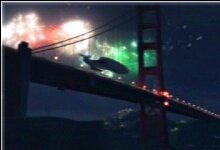 |
"These should be familiar images to everyone who remembers the USS Voyager's triumphant return to Earth after 23 years in the Delta Quadrant. Voyager captivated the hearts and minds of people throughout the Federation, so it seems fitting that on this, the tenth anniversary of their return we take a moment to recall the sacrifices made by the crew"
Initial scene of "Endgame"
|
For many years, both fans and writers have imagined Voyager's homecoming to include the actual landing of Voyager in Starfleet Headquarters, San Francisco, Earth, with a fantastic flyby over the Golden Gate Bridge, the sky lit by antimatter fireworks. This scenario has even been mentioned or alluded to on-screen before, in "Timeless" and "Bliss". Now in the series finale, the writers seem to fulfil their "promises" and the expectations of the viewers at least in this respect.
But - who would've imagined that we would see this celebration of homecoming in the very first scene of the episode, the teaser? It was quite a surprise, as well as the subsequent revelation that this is only a record of the actual homecoming displayed on some sort of television screen - played 26 years in the future, 10 years after Voyager's homecoming, 33 years after she stranded in the Delta Quadrant (I was pretty amazed that the writers did not screw up these numbers even once in the course of the episode). If we didn't believe the announcer's voice, the aged Kathryn Janeway (with white hair, but a so wrinkle-free face we can assume she has either a very good family doctor or uses some sort of anti-matter moisture creme...) leaves no doubt that this is the future.
Looking back, the intial scenes rank very high in comparison with the rest of the episode, right behind the denouement and the final moments. Just like the "Voyager buried under tons of ice" teaser in "Timeless", the premature depiction of this future event created a lot of pleasant anticipation and urged the viewer's curiosity on how it happened. Within 90 minutes, "Endgame" answers this question, but in a quite different way then originally expected. Since Voyager, of course, reached home after 7, not 23 years in the Delta Quadrant...
Admiral Janeway's future mission: a re-hash?
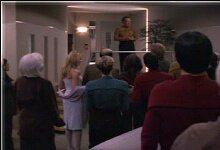 |
"Ten years ago tonight, this crew returned home from the longest away mission in Starfleet's history. Twenty-three years together made you a family, one I'm proud to have been adopted by. So let's raise our glasses. To the journey."
Cmd. Reginald Barclay to an aged crew, "Endgame I"
|
Once it becomes clear why Admiral Janeway calmly stays in her quarters on the anniversary of Voyager's homecoming, and what she intends to do, long-term viewers of the show might experience a strong déjà vu (as the Admiral puts it later in the episode). Especially because of the many (wonderful) scenes with Janeway and Kim both in the future and the present, which show up the similiarities of the two otherwise considerably different characters - their devotion to the family, their sometimes obsessive behaviour and their willingness to take many risks and bend or break the rules for the greater good - we get the feeling that this is "Timeless, part 2".
While the first part of "Endgame", until Janeway travels back to the present, "loans" from many episodes, the parallels to Voyager's own 100th episode are the most obvious: the intial scene (as mentioned above), the entire structure (continuously switching between the future and the present), the "unsatisfying" homecoming with many crew members lost (though this time it were "only" 22 in contrast to the 148 casualties in "Timeless"), and the both legally and morally doubtful attempt of a survivor to change the past and bring all crew members home safe and sound. The only striking difference between both scenarios is the way the past is changed (in "Timeless" only with a time travelling comm signal, in "Endgame" with an actual time travel), and the ending of the mission: in "Timeless", the plan more or less fails, and Voyager can't be brought home but stays in the Delta Quadrant, while now, of course, Voyager finds a way home thanks to the help of the time-travelling Admiral Janeway.
Speaking of time travel and stories set in different timelines, TNG's series finale "All Good Things..." had pretty similiar elements, too. The whole "alternate future", showing the Voyager crew aged, promoted and with a new life back on Earth, seems to be a rip-off from this two-parter. The writers were more than aware of that, giving the whole future setting a certain continuity to the "All Good Things..." future (as well as the one shown in "Future Imperfect" and "The Visitor") with similiar uniforms and commbadges. But there are even more resemblances to the TNG finale: Admiral Janeways attempts to make her crew members help her for "one last (quite illegal) mission" (Ambassador Picard's attempts), the neurological disease of Tuvok that is advanced in the future and was just identified in the present (Picard's neurological disease) and the involvement of a (more or less) Klingon officer (Ensign Miral vs. Ambassador Worf).
So all in all, one can say the writer's of "Endgame" really knew how to steal from Star Trek's best, obviously sticking to the saying "better an excellent plagiary than a medicore original". However, looking back and judging the two-parter concerning these re-hashes, especially in view of the very imaginative second part of the story the "stolen" elements don't bother me too much, since there are two more important issues concerning the alternate timeline and Admiral Janeway's mission that need some consideration.
The first question is, was it really necessary to devote the entire first part of the story (with some interruptions) to the presentation of an alternate future that will become irrelevant as soon as Admiral Janeway has succeeded and brought Voyager home earlier? We all know that crew member's future in the new timeline will be considerably different. Chakotay and Seven won't die and may marry (not that I could imagine this without throwing up my lunch), Tuvok won't be insane and could become Ambassador Spock's successor, and Janeway, as devoted as she is to her "family", would surely be a much happier human being than before. Consequently, many fans may be inclined to ask: what is the whole point of showing us this future? Why not cutting this short to the actual mission of Admiral Janeway and showing the real aftermath of the homecoming, the real reunion with their families and friends in the end? I don't have an answer either, but you could ask the same question concerning "All Good Things...", "Year of Hell", "Course: Oblivion" etc., all great episodes which spent lots of time showing us what eventually turns out not to be "the real thing".
Alternate futures have always been a popular element in Star Trek, giving the writers the freedom (and convenience) to write something about the characters beyond their established attitudes, traits and motives, putting this in contrast to the characters as we know them. In "Endgame", this works specially well for Captain Harry Kim, whose actor Garrett Wang - like in Timeless - does an extraordinary job in showing us a less-"childish" and more mature, dignified Harry, Cmd. Reginald Barclay, who appears much more dignified and self-confident as well (and doesn't stumble anymore!), and of course Admiral Janeway. While I will analyze the two contrasting Janeways later, it is obvious Kate Mulgrew has outdone herself this time.
So, the necessity of showing us an alternate future Voyager crew may not be given, especially in view of the fact that this is the last episode, but it was part of the writer's story they wanted to tell us before the homecoming. In contrast to "Deep Space Nine", there was very few serialization (key word: story arcs) in the episodic, plot-driven series "Star Trek: Voyager", and every episode was a stand-alone mission. We hadn't any build-up to the events in the finale in the last episodes, so it was quite clear that "Endgame" would be more like a typical "Voyager telemovie" such as "Year of Hell" and "Dark Frontier" than like a true summary or conclusion to the characters and the events of the entire seven years. "Endgame" gives us a distinct story which eventually leads to the homecoming, the most (and maybe only) important common element throughout the series, and that's typical Voyager.
The second problem with Janeway's mission may be more significant for all Star Trek fans who see more in the series than science fiction and character drama, but want some sort of message, a human(ist) underlying meaning in "their" Star Trek. As I said in the beginning, Star Trek was always most successful when it expressed something general about humanity, when it included little moral tales. That's why "Star Trek: First Contact" was such an immense hit: despite all action, it ran deep enough to submit some important ideas and truths about mankind with the general plot as well as the three-dimensional characters.
But what about the Voyager finale? We really have to consider it:
The moral background of Endgame
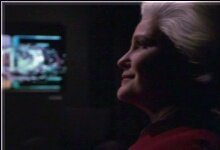 |
"I'm not talking about technology, I'm talking about people - people who weren't as lucky as you and me. You said you and the Doctor wanted to 'keep things in the family'. But our family's not complete anymore, is it? I'm asking you to trust my judgment, Harry...one last time."
Admiral Janeway to Captain Harry Kim, "Endgame I"
|
If I had only watched the first part of "Endgame", I would have seriously asked: "What moral background?".
With travelling back in time to bring Voyager home earlier, thus affecting the entire timeline, Admiral Janeway bluntly violates the Temporal Prime Directive (as mentioned, but not further elaborated in the episode), and she causes a moral dilemma that needs to be discussed. There have been very often attempts on behalf of the fans to court martial Kathryn Janeway. Now, from an objective point of view, Admiral Janeway would definitely deserve one for
- abusing her power to induce a Starfleet Lieutenant to crimes and to support a very shady Klingon (Korath) to get a seat in Klingon High Council in exchange of an temporal device, thus interfering with internal Klingon politics (the Federation charta clearly forbids this - "Inter Arma Enim Silent Leges")
- abusing her contacts to get an experimental, top-secret drug from Starfleet Medical
- abusing her personal contacts to a Starfleet captain, inducing him not to take her into custody and to fire at a (supposed) ally (the Klingons).
- and finally, as the most important point, deliberately ignoring the Temporal Prime Directive and tampering with the timeline - a very risky procedure, as she admits.
She (selfishly?) commits all this crimes for her "family", because of the death of 22 of her former crewmembers, the insanity of one (Tuvok) plus the extension of Voyager's journey in the Delta Quadrant by 16 additional years.
You may say, she just acts like Captain Kirk in "Star Trek III" according to the (reversed) saying "The needs of the few outweigh the needs of the many". The reasons (to save friends or "family members") may be the same, however, there is a huge difference between stealing the own starship to travel to a forbidden planet and altering the entire timeline, thus affecting the lives of millions.
If we look at it objectively, Admiral Janeways actions aren't any different from the desperate actions of Annorax in the "Year of Hell" two-parter: they both change the timeline with the intention to undo a personal loss, and they are both willing to play God and risk everything for this goal. Who says that the new timeline (indeed Admiral Janeway does not alter the timeline by rewriting history and obliterating her own - actually original! - future, but a new - actually alternate! - timeline with a different future is created when she changes the past - at least the TNG episode "Parallels" with its indefinite number of "quantum realities" established these aspects of temporal mechanics) will be any better than the old one? Who is Janeway that she decides what will be better for millions of other people? The cute daughter of Naomi, who might be never born in the new timeline, is only one example we know of. This is definitely a megalomanic trait in Janeway's character.
By the way, the same judgment could be applied to Harry Kim in "Timeless", though he had better reasons: then, the entire crew except him and Chakotay did not made it, and he was somehow directly personally responsible for the catastrophe.
Admiral Janeway wasn't - the loss of the crew members and other hardships during the 16 additional years were - as cruel as it sounds - fate. A professional captain has to realize that he *will* lose crewmembers no matter what he attempts to prevent this. Actually, he has to know that to become a captain. Of course, there is a difference between knowledge and acceptance. Captain Kirk always knew this basic fact, but never accepted it. He lived according to the optimistic approach that there is a solution to every situation, no matter how hopeless it looks. This was a basic theme in "Star Trek II" and "Star Trek III". At the end of the first movie, when Spock died, he recognized for the first time that it's not always possible to "deceive the death", but, then again, in the latter movie he proved the opposite, in a very Star Trek like, but in reality impossible step, bringing his friend back to life.
Admiral Janeway is very similiar to James T. Kirk in this respect (she simply does what she thinks is right and doesn't care about paragraphs and regulations in this moment), with the difference that Kirk knew where to draw a line.
So, if the aforementioned points would really concern the Kathryn Janeway we all know and love, this would be a serious negative aspect of the episode. As every good Starfleet captain, Janeway did not follow blindly the Starfleet regulations, but bended the rules (like the Prime Directive) from time to time if she had good reason. However, she never committed a crime like the ones mentioned above, with the exception of "Equinox II", an awful episode I like to regard as uncanon.
So we really have to differentiate between the present Captain Janeway and the (alternate) future Admiral Janeway. Admiral Janeway is like a darker, far more desparate version of our captain, and thanks to Kate Mulgrew's probably most outstanding performance ever (easily beating her own double Janeway premiere in the season 2 episode "Deadlock"), there seem to be really two Janeways with more than different hair colour, but different gestures, different pronounciations, different attitudes.
Both captains are driven by the same dangerous, yet understandable traits: the guilt that she stranded the crew of Voyager in the Delta Quadrant ("Caretaker") and thus "caused" the various deaths and hardships, and the consequential obsessive determination to bring them all home safe and sound in order to "keep her promise" and redeem her "mistake" (this "rescue them all" attitude seems to be a general aspect of Janeway's character, judging the events in her younger years described in Jeri Taylor's "Mosaic"). As we've seen in the course of the series, Janeways obsession has a very positive effect on the crew, which has become her "family", explaining the strong feelings of Janeway and her intention to rescue her "entire flock of sheeps", and the journey, which could be shortened several times because of her efforts, as long as the situation remains controllable. "Night" and "Friendship One" have shown that this changes in times of hardships, with both episodes including a strong emotional reaction of Janeway because of hardships during the journey and the death of a "family member", respectively. In this respect, Admiral Janeway is indeed very "Janeway", but her actions are no longer justifiable. She's become more self-righteous, megalomanic, even unscrupulous over the years. As I said, this is acceptable in light of the fact that this is only a possible version of our Janeway.
However, expanding our view from the Star Trek universe per se to the general significance of the shown actions in terms of morality and ethics, this can only be regarded as a pretty doubtful message. Consequently, part one of "Endgame" should be regarded as "story only" without much deep thought and psychological background, while - fortunately - part two explores the full range of moral reasons and consequences with the interaction of Captain Janeway and Admiral Janeway.
Speaking of parts one and two in general, I would have been quite disappointed if the series finale would have involved nothing more than the aspects the rumors and full-blown spoilers mentioned - (morally questionable) time travel and Klingons as the popular, all too well-known Star Trek elements, the depiction of an alternate future just like in the "Star Trek: The Next Generation" finale and other unimaginative rehashes of various episodes and movies.
Amazingly, while the first part, though introducing the two common themes of the two-parter - family and the journey -, seemed to confirm my apprehensions, as it is nice entertainment with a lot of memorable scenes, but lacks real twists, unique ideas and, as shown above, the Star Trek typical moral background, everything became different once Admiral Janeway left the future and the action in Voyager's present began. There are surprises, turns and lots of action, but most important, there finally is the deeper meaning I've yearned for in the build-up part: excellent dialogues, moral decisions and larger Star Trek themes, including the exploration of the human condition (mostly with the two Janeways).
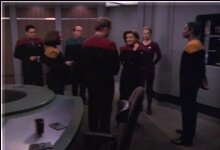 |
"A long time ago, I made a decision that stranded this crew in the Delta Quadrant. I don't regret that decision. But I didn't know all of you then, and Voyager was just a starship. It's much more than that now. It's become our home. I know I could order you to carry out this plan, and none of you would hesitate for a second. But I'm not going to do that. You know the crewmen who work under you, and you know what your own hearts are telling you. So we're not going to attempt this unless everyone in this room agrees."
Captain Janeway to the "family", "Endgame II"
|
Up to the unexpected discovery in the nebula, which ultimately plays an extraordinary role for the homecoming of Voyager and is one of the key elements in "Endgame", nothing seemed to indicate that there would be some more discussion on the actions and plans of Admiral Janeway. Indeed, it seemed that not only the future Harry Kim (by letting the Admiral go and defending her against the Klingons), but also the present Captain Janeway seemed to put her own and the crew's fate over the greater good. She got to know lots of things about the future, supported the efforts of the Admiral and let her equip Voyager with the future technology.
While this is already very questionable in terms of the Temporal Prime Directive ("To hell with it"), then the moment came to decide between right and wrong, Kathryn Janeway's heart was at the right place.
Trusting the spoilers, I had really believed that with the help of Admiral Janeway, the crew would discover a wormhole and travel home. End. Hence, I was very, very delighted by the surprise twist the writers added in the crucial (second) nebula scene, and the consequential character scenes eventually made me grow fond of the finale: the wormhole actually is a "transwarp hub", an important part of the Galactic Borg transportation system, whose destruction could save the life of millions, since the Borg then couldn't use their "prefabricated" transwarp conduits to reach and assimilate distant planets within minutes (a serious danger impressively shown with Icheb's home planet in "Child's Play").
However, this twist is more than a plot complication to make Voyager's homecoming more difficult. It is a parallel to the pilot of Voyager, "Caretaker", and the initial premise that Voyager is stranded in the Delta Quadrant because of the decision of its captain to sacrifice the crew's and her own "convenience" for the greater good, namely the lives of an entire civilization (the Ocampa).
Now, in the new situation, Admiral Janeway, who regards her younger self's decision to help the Ocampa as a mistake, is so determined to bring her crew home that she doesn't see the opportunity, and doesn't want to see it anyway.
Yet, as pointed out, Captain Janeway isn't Admiral Janeway. The captain is driven by her shortsighted determination and her humanist Federation ideals as well, however, her decision not to take the quick route home, but to leave the nebula and work out a way to destroy the hub (similiar to the destruction of the Caretaker's array) clearly shows what comes first. At this time, with hope and optimism and not despair and loneliness dominating, Janeway has no reason to act different than she did in "Caretaker". More like a Captain Picard than a Captain Kirk, and definitely not like Admiral Janeway, Captain Janeway is willing to make that noble sacrifice again. The needs of the many DO outweigh the needs of the few - as Tuvok puts it with this insightful Spock quote from "Star Trek II". Yet, one thing is different from "Caretaker": Janeway doesn't want to selfishly enforce this to her "family" as well.
In this respect, the conference room scene is the most important one (and my favorite) in "Endgame II". It is a very emotional moment with excellent dialogue, emphasizing both themes of the finale and serving as a replacement for the (unfortunately) missing epilogue scene. The family is together, and unlike "Caretaker", where Janeway speaks for all of them, as well as unlike "Night", where it's the crew who comes up with the plan, this time they all decide. As Janeway points out, Voyager has become much more than a starship, it's the family's home away from home, reflecting the probably best scene ever in "Year of Hell II" where Janeway said something similiar to Tuvok, staying on the sinking ship. Unfortunately, this scene did never happen since all events in "YoH" were obliterated by the infamous "reset button", however, this time it is real.
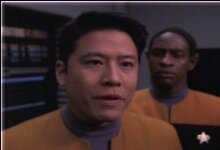 |
"I think it's safe to say that no one on this crew has been more...obsessed with getting home than I have. But, when I think about everything we've been through together, maybe it's not the destination that matters. Maybe it's the journey. And if that journey takes a little longer so we can do something we all believe in, I can't think of any place I'd rather be, or any people I'd rather be with." - "To the journey!"
Harry Kim and Tom Paris, "Endgame II"
|
Surprisingly, it is Harry Kim of all crew members who speaks the decisive words, underlining the extraordinary role Garrett Wang's character has in the series finale: "Maybe it's not the destination that matters, but the journey" he says, reflecting an old Buddhist principle that has found it's way to modern pop culture in the last decades - from "the journey is the destination" to "life is a journey, not a destination". As I said in the beginning, during their journeys in the Delta Quadrant, they never forgot their original goal, to find a way back to Earth. However, if they spent all those years with racing home at high warp, ignoring the opportunities along the road, and invested every hour of their life in finding a way home, wouldn't they've lost more than they've won? Beside the fact that every missed opportunity to explore could be a missed way home (shown in "The Voyager Conspiracy", where they originally wanted to explore a nebula and finally discovered the space catapult), their lives then would've been more than empty.
So I really liked this basic truth to be mentioned in the finale. It pretty much summarizes the way the crew finally sees their fate in the Delta Quadrant after seven years. In the beginning, there was of course homesickness and loneliness, but as the crew (or, more precisely, both crews) grew together in this hopeless situation, they more and more put up with it. "It is no longer the question if we find a way home, but when." Janeway said after the experiences in "Timeless", and at least from that moment on they truly enjoyed their time together, from their view no longer stuck in a hostile region of space, but exploring a quadrant full of wonders and opportunities.
And, it seems only fitting that now in "Endgame", when the crew realizes that even if they will still spent years with travelling home they've a great time together, they get the chance to actually return to Earth.
Janeway and Janeway: a double whammy
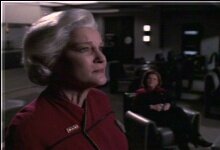 |
"I'd been so determined to get this crew home for so many years that I think I forgot how much they loved being together - and how loyal they were to you. It's taken me a few days to realize it: this is your ship, your crew - not mine. I was wrong to lie to you. To think I could talk you out of something you'd set your mind to."
Admiral Janeway to Captain Janeway, "Endgame II"
|
In the end, it's not only the crew that is convinced of the Captain's "intergalactic good-will mission", her plan to destroy the transwarp hub and deal a crippling blow to the Borg.
Finally, also Admiral Janeway rediscover her younger self's passion not only for her crew, but also for her ideals. What she still called "doing something stupid" before the family meeting in the conference room is now an "old habit" that she wants to revive. And while she tried to convince Captain Janeway and certain crew members (who even if they will be harmed or killed do not concur, impressively showing their Federation "self-sacrifice for the greater good" education) that it's not worth to rescue the lives of "strangers in a hypothetical scenario" in favor of the lives of "collegues, friends in real life" (again according to "the needs of the few outweigh the needs of the many"), she begins to understand - and agree with - her younger self afterwards.
From that moment on Janeway and Janeway don't work separated (in different time frames) or against each other anymore. They work together, and just like Captain Kirk in "Star Trek III" they find a way to "deceive death", to save the galaxy and the day, i.e. to destroy the Borg transwarp network and bring the crew home. I'd like to call this turn in "Endgame" the Talaxian solution, according to Neelix' saying in "Author, Author": "when the road before you splits in two, take the third path".
How every fan judges this development depends on how he sees Star Trek. Granted, it's completely unrealistic and does not deliver a very useful message either. Already children learn that you must decide between two things, but usually can't have both. And: you always have to put something in the scale, you must make sacrifices in one way or another if you want to achieve something - especially if it's so far-reaching as Janeway's goal.
"Star Trek: Deep Space Nine" would never have done something like this; there, every action had either positive or negative consequences (for example, to prevent the loss of the war, Captain Sisko had to sacrifice his ethics and make the Romulans take part in "Inter Arma Enim Silent Leges"). Yet, for good or for bad, this may be more realistic, but isn't typical Star Trek in my opinion. The optimism of the saga always resembled more a Utopian idealism than a positive realism, as pointed out with Captain Kirk and the feature films. That's because to my mind, Star Trek never depicted any form of realistic future society, but submitted a vision of a desired human future, with a message of hope and confidence that attracted the viewers for 35 years.
For both good and bad, the finale, with all its facets, submits an opinion which to my mind has been a common, very Roddenberryan philosophy throughout the entire series - we can achieve everything we want if we are determined, never lose our hope in these dreams and try to realize them.
For seven years, the crew has never gave up the hope (if not obsession) that they will reach Earth one day, although, as Annorax (another one who's obsessed by a personal goal) put it in "Year of Hell", their chances are astronomically low. In "Dark Frontier", Janeway believed she could rescue Seven of Nine from the Borg collective, the most powerful adversary the Federation ever had. In "Endgame I", Admiral Janeway believed she could travel back in time to create a new, a better future for her crew. Now, both Janeways, and the crew, believe they can carry out this double mission. With such a determination, and such a belief, who can seriously doubt they will eventually succeed?
The losers of the Endgame - the Borg
 |
"You wish to ensure the well-being of your collective. I can appreciate that. I'll help you. But it'll cost more than you're offering."
The Borg Queen to Admiral Janeway, "Endgame II"
|
In the series finale, the Borg are back after nearly one season of absence, and they are creepier than ever before - thanks to the Borg queen actress Alice Krige, who already played the queen in "Star Trek: First Contact" and now returns to give an absolutely outstanding performance. Susanna Thompson was a nice Borg queen in "Dark Frontier" and "Unimatrix Zero", but, nonetheless, Krige is still another class. With gracefully movements and aspirated words, her Queen's so seductive and deadly at once, one could think her smile alone can assimilate you (see above picture). Fortunately, the Queen isn't written the way it was done in "Unimatrix Zero". She appears again to be the worthy adversary she was in both the eigth feature film and "Dark Frontier", the head of an entire species of cyborgs, not the emotional, babbling second-class-enemy she used to be in said episode. Now, she doesn't lose many words but acts (the quick assimilation of Admiral Janeway), and always keeps cool - even when she lies on the floor without extremities, passing away, she is sure "Janeway is about to die".
Allan Kroeker's direction perfects the Borg appearance in the series finale - the lighting is darker, the "Borg flashes" brighter and more frequent, and although we don't see many Borg beside the Queen, the scary voice of the Collective adds much to the familiar "Borg feeling".
Unfortunately, due to the direction the story takes the Borg also appear weaker than ever before. With Admiral Janeway's unimaginable revelation that there will be ways not only to defend against them, but to defeat them in thirty years, the mythos of the pitiless, invincible enemy is ultimately destructed. In this moment, I could only remember Guinan's remark in the very first Borg episode in "The Next Generation", "Q Who", that their might be a status quo with the Borg in ten thousand years, but at the moment, their's nothing they can do against them. But then, Guinan possibly didn't know that there would be a Captain Janeway (in the original time line) travelling for 23 years through the Borg's home quadrant, having plenty of time to study (and steal!) their technology. After all, the technological ascension of the Federation then doesn't sound as incredible anymore, however, it is, in terms of storytelling, still a too big, a too far-reaching step.
Once both Janeways have settled their plan - to infect the Borg queen with a neural pathogen (most likely the one discovered in "Collective", not the synthetic virus from "Infinite Regress") in order to disrupt the control over the shields of the interspatial manifolds so that Voyager can destroy one of them with the known consequences from a save distance within the corridor to Earth, allowing the crew to still travel home while the conduit collapses behind them - and the Admiral leaves Voyager with her shuttle, heading for the Queen's Unicomplex, the fate of the Borg appears to be sealed: the endgame of the endgame, of course, takes place between the two queens - Janeway (just remember Tom's saying in "Bride of Chaotica!": "You are the Queen!") and the Borg Queen.
However, the final outcome is not decided before yet another turn: Admiral Janeway's unexpected offer to the Borg Queen to hand over all that future technology. This could be a final admission to the Temporal Prime Directive, according to which the adaptation of the Borg to the technology would only reestablish the balance of powers, since it was not meant to be in the hands of the Federation that early. Or is it just a possible Starfleet-like diplomatic solution Janeway offers to the Queen, before she proceeds with her real plan? You all know the Captain's saying "When diplomacy fails, we need a backup plan" ("Shattered"). However, it could be also "When diplomacy fails, there's only one alternative - violence" ("Living Witness") in this case...
On the other hand, Janeway could be really the impostor Tuvok continuously mentioned in the future - the hint that she was abducted by a hostile species some time ago (and possibly replaced by the Borg?) is further "evidence" for that theory. But, as we wouldn't have known it, everything seems to be a part of the plan. Even the discovery of the Admiral and her assimilation must be intentional (but then, we all know Kathy does enjoy a good dose of nanoprobes for the sake of the Galaxy - see "Unimatrix Zero"). Everything happens as the Admiral has predicted it: she sacrifices her live (because the ship, if not the entire Galaxy, is far too small for two Kathryn Janeways...) for the homecoming of the crew, and takes the Borg Queen with her. Both the Admiral's and the Queen's final moments are tremendous and scary - explosions in the whole chamber, the Queen dissects, and Janeway - half assimilated - looks awful as well, but they are both more poisonous than ever before. "You underestimated US". The ultimate triumph of Janeway over the Borg Queen. The entire scene was a quite shocking experience. If I hadn't known it before, I was now sure: Ken Biller's announcement of a "rip-roaring, slam-bang action adventure" was more than fitting...
Finally, huge parts of the Unicomplex explode, and, thanks to Voyager, the transwarp network of the Borg will eventually be obliterated. It worked. But what about the major aspect of the plan - Voyager's return to Earth?
The ultimate twist - the homecoming
 |
"We did it."
Captain Janeway, "Endgame II"
|
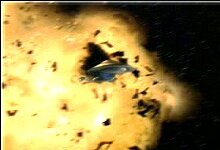
Of course - praised be the plot complication - the Queen lived long enough to order one sphere to pursue and assimilate Voyager in the transwarp conduit. With the sphere adapting to the armor and weapons (which have been assimilated from the Admiral together with pathogen, of course), Voyager hasn't any chance to withstand. She can't stay ahead of the Borg vessel and has to leave the conduit with the next possiple exit aperture - what would bring the ship back to the Delta Quadrant.
Just in the moment we believed the battle is over and nothing more could happen, everything is open again...
This situation, the episode's climax, really was the ultimate twist of the entire series finale, and probably the most decisive one regarding the homecoming question. The solution of it: well, as I've experienced it, the ending was the most clever and surprising one I've ever seen in Star Trek - this was a ending worth of seven years waiting and asking "Will they finally make it?". When Janeway ordered Tom to alter course (to the Delta exit aperture, the audience had to assume), and the sphere left the conduit to the Alpha Quadrant alone, "welcomed" by a dozen Starfleet vessels, I thought the crew was really back in the Delta Quadrant, having sacrificed their homecoming, their personal luck again for the greater good. I was shocked.
But when Borg sphere exploded - obviously far too easily -, the music grew louder, and our favorite starship left the flames with a majestic fly-by over to the waiting Starfleet vessels... I could only cheer. It was so unbelievable, I had to watch the scene again... and again.
Apparently, Voyager hid either deliberately in the sphere or was tractored in - we don't know for sure, since we only see for a short moment how a sphere portal opens and then we see nothing but the bridge of Voyager.
To my mind, it was an amazingly clever scene, and as I've noticed, many fans were as sceptical as I was - "What? They were inside??". After all, no one would have expected a denouement like this - less than two minutes before the end credits!
The final scenes
 |
"Set a course... for home."
Captain Janeway, "Endgame II"
|
When the writers created the series finale, they had two choices: either a quick homecoming in the first hour (like the early ending of the Dominion war in DS9's "What You Leave Behind"), with some time in the end for dealing with the immediate aftermath of the homecoming and its consequences, or a homecoming that remains undecided as long as possible, in order to end the finale with a bang. As we all know, the writers decided for the latter version and the Star Trek typical "short story" style. No prologue, no epilogue. Just the story, which ends right after the climax.
It is only natural that many were not satisfied with such an ending. After Voyager has left the sphere and stopped in front of the fleet, there's only one scene with a short talk between Janeway and Pathfinder, a short look at Tom's and B'Elanna's baby, born just in that moment of the ultimate triumph, and the final words of Janeway. Even the final exterior look - Voyager, accompanied by the fleet, flying to Earth - seems to be awfully short, and the end credits really surprises the viewer who hasn't even "overcome" the big bang of the final twist yet.
But, after watching the final scenes probably half a dozen times, I must say that they really have their own flair, and seem very, very true in view of what the episode showed us in the past 90 minutes, and what it stands for.
Granted, with regard to the characters, the ending is an open one. We don't see Paris' reunion with his father, Kim's meeting with his parents (and his promotion, of course), the Doctor's and Seven's fate as the "outsiders" of the crew. Some of these aspects have been dealt with before in one way or another (in "Author, Author", for example).
But anyway, the finale was, as I said in the beginning, entirely about the homecoming, the question if they really return to Earth, and that question has been definitely answered.
So in consideration of the style of "Endgame", I don't mind that the writers left all other issues to the imagination of the audience.
I really couldn't enjoy those scenes the first time I watched them the way I enjoy them now, because I was just too "narcotized" by the events before. However, as soon as I'd comprehended and accepted the way they came home and the way the episode ended, the final moments unfolded their full emotional impact.
And I can only say that the actors and production crew have made the most out of them. No cheers, no celebration. The calmness of the moment is dazzling, and quite realistic if we imagine how overwhelmed the crew must be because of the surprising homecoming.
Just as we were overwhelmed by the final twist and the unbelievable way Voyager entered the Alpha Quadrant, the crew must have thought they were caught in the Delta Quadrant again - and just in that moment, when they leave the exploding sphere in hope and fear, they fly straight toward a fleet of Starfleet vessels - and know that they're finally home.
How could this moment have been depicted in a more perfect way? "We did it." Soft words, spoken by Janeway with confidence, but still surprise and disbelief. The first "regional call" of Starfleet takes place in this tense, quite formal atmosphere, which is finally broken when the first cries of Miral Paris reach the crew from the comm system. Suddenly we discover smiles, watered eyes, and faces that show the joy the crew experiences in this moment. Especially the facial expressions of Janeway - who delivers one last time her famous smile (we've seen only once before in the finale - in the Admiral/Captain farewell scene aboard the shuttle) - and Harry Kim (who extraordinarily shows how it looks if you want to cry and laugh at the same time) are absolutely priceless.
Then Janeway speaks her final words, which are essentially the same as at the end of the pilot, "Caretaker": "Set a course... for home". Just as the entire scene, the perfection of these words does only show up after repeated watching - they express that in both cases, in the pilot as well as the finale, Voyager is about to depart, heading back to Earth. The difference is only the distance. "Home" is a planet in a distant, 75000 light years away part of the Galaxy in the pilot, but now, it's the familiar blue marble less than a light year away.
Beside drawing a bow between pilot and finale, Janeway's final words also somehow reflect the entire series, and the common thoughts behind it. Despite the Starfleet mission, Voyager and its crew have maintained the course home for seven years, in every episode. Furthermore, this "train of thought" in all 172 episodes at once represented the Star Trek vision I've pointed out with the plan of both Janeways - that with man's determination alone, imagination can become reality, that you can reach everything you really want. Seven years before, Voyager's journey home was a matter of decades. Due to the inexhaustible belief and fight for their goal, the crew has turned fiction into reality; their journey is now only a matter of hours.
I now see the homecoming this way, when I watch the very last moments of the series, with Voyager smoothly moving towards its final destination.
However, the moment the screen turns black and the end credits appear is still a moment of a merciless finality: it's over. This is the journey's end.

The "three C's" in "Endgame"
After an 8,000 words essay on the series finale, you may expect me to say that where is little more to add. However, there are still some general issues that need to be considered to complete the image of "Endgame"; issues that didn't quite fit the more or less chronological review of the final episode.
In the very beginning, I mentioned that a typical "trademark" of Voyager were the far-reaching compromises the writers are very often willing to make for the sake of the story. Some people may even consider this a good thing, but especially those who prefer the new serialized forms of television (à la "Babylon 5") over the classic episodic format will say that overall continuity, character consistency and the awareness of consequences are three major aspects of good storytelling that may not be neglected. While I am a huge fan of the original, "mission-based" Trek, as a stickler with small background details and hints to continuity, I tend to agree with this opinion.
And while I'm inclined not to take the various "loans" of the series finale from former episodes that serious (especially since the writers really succeeded in combining all those too well-known bits and pieces from over thirty years Star Trek to a exciting new melange), except the cases their it really only costed time that could have been better used in the end (for example the entire "Klingon heist" scenes that added nothing to the plot but could have reduced to the dialog line "I've stolen it from the Klingons, now they pursue me"), I'm not delighted by the various "liberties" the finale takes in terms of "newly invented plot elements".
 |
"The only certainty is how we feel about each other here and now. If you think I'm going to let you end this because of what might happen...Then you need to get to know me a little better."
Chakotay and Seven, "Endgame"
|
I am speaking of such "minor issues" as the entire Chakotay/Seven relationship. Although I am not a die-hard Janeway/Chakotay fan like many other Trekkers, because I am not primarily interested in the Star Trek relationships, this is one of the worst things in "Endgame". To tell the truth, this relationship, whether it's a friendship or involves intimate relations, comes totally out of the blue. In the four years Seven is aboard Voyager, she had a few personal scenes with the First Officer in "The Omega Directive", a few ones in "Demon", and recently some more scenes (most probably as a "preparation" for the romance) in "Human Error" and "Natural Law". Needless to say, none of these scenes did include moments that could be regarded as "the two coming close" or even "sexual tension". Sadly for Robert Beltran, who believed the opposite, there was never any sexual tension - and any of that non-describable thing we usually call "chemistry" - between him and "Seven" actress Jeri Ryan. So this whole, full-fledged romance in "Endgame" is a very unpleasant surprise, for perhaps 90% of all fans who really care for the character, and the worst aspect is, it isn't executed very well either. Not that the director didn't try - the music is very cute in the "C/7" moments - but these two characters - the First Officer in his forties, mature and with lots of responsibility, and the Ex-Borg in her twenties, totally unexperienced with this kind of emotions, simply doesn't go together. It's a complete mischaracterization of Seven, since she was never willing to pursue them, as seen in "Someone To Watch Over Me" and "Unimatrix Zero", and was not able to react that human up to now! And suddenly, she is grinning all the time, and fully enjoying her first real (cliche) romance. Conveniently, the plot device added in "Human Error" just to prevent such a development (a failsafe mechanism that causes the drone to "shutdown" in case of stronger emotions) can now be easily removed. Do you remember how both Ryan and the producers pronounced at that time how Seven was intended to be "dramatically taken away from becoming human" and how happy everybody was that she would become "some sort of tragic figure"? Well, it seems producers change their minds at warp speed...
If it is not a last-minute-decision of the writers ("Hey, let's add some romance, this attracts the audience!"), or, as hinted by Beltran, some sort of challenge between him, Ryan and "Endgame" co-author Brannon Braga, I don't know what it is. At least, perhaps as a poetic justice, the performances of both Beltran and Ryan are more than insignificant for the finale - they both have very few scenes beside the ones together, and those "romantic encounters" don't add anything to the finale (beside the rather coincidental match with one of the "Endgame" themes - a relationship is often regarded as a "journey without destination" as well). You could remove them and no one would realize that something is missing. So I don't think these scenes, which considerably harm the character consistency of Seven and also Chakotay (because of the mentioned "zero-relationship", if not slight hostility between them up to now - still in "Dark Frontier", Chakotay had the opinion that it was perhaps predestined that Seven cannot become human and will eventually return to the Borg), spoil my positive feelings for "Endgame" too much, however, I can understand those fans who want to obliterate the two-parter from their memories. With this "just for fun relationship", perhaps the climax of the long Voyager tradition of non-continuity and mischaracterization, the writers have really gone too far.
In comparison to this, of course, the other elements conventiently invented for the "Endgame" story don't seem too bad. Tuvok's mental disease wasn't mentioned before, but after all, he didn't tell anyone but the Doctor, so it's no problem to assume the corresponding scenes were off-screen. The same applies to the "transwarp hubs", which were also firstly introduced in this episode. Obviously, the "Endgame" corridors are not the same "dynamic" conduits shown and used in "Dark Frontier" (different color, transwarp coil necessary), but resemble the pre-fabricated passages shown in TNG's "Descent" two-parter and "Child's Play". Given the many things the intergalactic transportation system of the Borg explains, I don't have any problems with that.
 |
"Bridge to Engineering. Deploy armor."
Captain Janeway, "Endgame"
|
If we discuss the past, and thus continuity, we can't omit the future, and consequences. With their passion for new fantastic technologies and inventions, the writers of Voyager have particularly neglected this "c-word" among the others. We really can't blame them. I mentioned it several times before - Star Trek was always about turning fiction into reality, about realizing one's dreams with optimism and determination. The bad outcome of this aspect, if you pursue it too intensenly, is that all limits, all restrictions finally become obsolete. In terms of Star Trek, this means that our heros eventually become two powerful, and the Federation turns into a "super power" that can't even be beaten by the Borg. Unfortunately, this has exactly happened after "Endgame", and may explain why the producers left the 24th century and now explore the 22nd with Voyager's successor "Enterprise" (confer my analysis on the reasons for the "Enterprise" premise in issue 7). Speaking of science and technology, and the traditional exploration of relatively small parts of the Star Trek Galaxy, there's not much left to explore in the "Voyager" future. The series introduced propulsion systems with which you can travel 10,000 light years within weeks (the Quantum-Slipstream-Drive from "Hope and Fear" and "Timeless"), intergalactic realtime communication ("Author, Author") and fully self-conscious, autonomous holograms.
Now, due to the violation of the Temporal Prime Directive in "Endgame", Voyager obviously gives the Federation both defensive and offensive weapon technologies (the armor, transphasic torpedoes and perhaps even other technologies saved in the databanks of Admiral Janeway's shuttle) from the future that enable Starfleet to defeat the Borg! You can clearly see how a fully equipped Voyager reaches Earth in the end of the series finale. Of course, the writers must have been aware of this problem (and they can't simply say we're now exploring the 22nd century so it's none of our business, because "Star Trek X" will take place in the aftermath of Voyager's homecoming), and indeed their are several possibilities to solve the problems.
First, the fact that these weapons from the future are here isn't necessarily a violation of the Temporal Prime Directive. Ethically correct, Starfleet could lock those technologies away and prohibit its usage, however, than they will never have it. We have to keep in mind that they were only invented because originally the Voyager crew stayed 16 years longer in the Delta Quadrant and had plenty of time to study the Borg and consequently develop these counter-measurements in order to survive. In the new timeline, Voyager came home after seven years and doesn't have these additional experiences with the Borg, so that in thirty years, the mentioned weapons have most probably not been developed. Within the constraints of the episode, it then may be acceptible that the Federation nevertheless gets the technology (from Voyager), however, in view of future stories the writers should have shown more carefulness with introducing such powerful "plot devices", with which they can destroy a Borg cube with one shot. It is always bad dramatization if a situation is solved by high tech gizmos instead of real human strength, so despite the "coolness-factor", I can't give "Endgame" extra-points for this.
On the other hand, the finale offers loopholes to at least compensate the power of the new weapons. As we know, before her death, the Borg Queen has assimilated both the virus and the armor technology. In the final scenes, Voyager's defensive and offensive potential doesn't seem to be compromised too much by this, however, we can assume that the sphere hadn't adapted fully to the technologies (including those cool new torpedoes) and at least transferred the assimiliated information to other ships before its destruction. So it's quite possible that everything Starfleet got isn't a danger for the Borg anymore.
But then, it's very improbable we'll ever see the Borg again. With this the series finale, Voyager has managed to destroy the Collective more or less, and I really mean that literally and not in the ironic sense many fans would assume regarding the fourth Star Trek series and the Borg. The destruction of the transwarp network, the Unicomplex, the Queen's chamber, and, of course, the Queen herself indeed marks a "crippling blow" against the once so powerful species.
Though the finale, as with so many other subjects, doesn't state something definite concerning the fate of the Borg, the hive surely is far from being completely destroyed (every action intending that would be genocide, as discussed in TNG's "I, Hugh"), but Voyager succeeded in bringing "chaos to order", as Admiral Janeway put it. The Borg are now lacking perfection, the harmony and the control more than ever before, and that's were greatest weakness. Even if there are still thousands of cubes out there, ready to assimilate hundreds of species, after "Unimatrix Zero II" now another step has been done to destroy the Collective from inside. So retrospectively, it's not so bad that "Endgame" did adress the Borg resistance movement from the season 7 opener only in the trivia section (during Barclay's lesson in the future), since every long-term fan will know that the events here may be decisive factor to allow the "Borg individuals" to spread and finally take control over the former Collective. As I said, we don't know for sure, but perhaps the next movie will include some remarks on the ultimate development.
However, concerning the impact the new technology may have on the Federation, we also have to ask: if these weapons have done such a great deal of damage to the Borg, wouldn't it make the Federation superior to any other power in the quadrant, that, in addition, could never adapt to it? My explanation: the armor and the torpedos were especially designed to fight the Borg, fitting the Admiral's explanation that those devices were developed because of further experiences with the Collective. Hence, the (somehow) regenerative armor is probably only so superior because the Borg cannot adapt to him easily (unlike with shields, there's no "energy frequency" you can match), and the torpedos are maybe not more powerful than normal photon torpedos, but take advantage of certain special weaknesses of the Borg (the energy nods from "Best of Both Worlds", for example). Well, that should suffice to rationalize the errors of "Endgame". You may already consider me "anti-human" with my eagerness to make the Collective more powerful...
Conclusion
After almost every imaginable - positive or negative - aspect of "Endgame" should have been covered, the time has come for a final assessment of the series finale.
As you may have experienced while reading this review, all in all I was delighted, despite or perhaps because the finale did not fulfil all of my expectations, but delivered some outright surprises, and, after all, gave me a lot to think about.
Of course, the story made "Endgame" a Janeway (double) vehicle, and as an avid fan of the first female Star Trek series captain and her admirable actress, Kate Mulgrew, I couldn't help but love this episode.
Anyway, for me, as a quite liberal fan, there's not much to loathe in it: despite Janeway's dominance, the finale was a more or less a true ensemble show, with memorable scenes for really everyone. You truly got the impression that the writers tried to write at least one scene for every important relationship, even the ones that have been neglected in the past seasons (most notably Janeway/Tuvok).
The character scenes especially raised my views of the first part, that is somehow unimaginative and lackluster in comparison to the unbeatable second part. Despite the length of this analysis, I haven't appreciated them all: the eye-watering Janeway/Tuvok farewell in the future, a scene that comes right after the pivotal J/T farewell scene in "Year of Hell", the light Janeway/Chakotay moments in the present and the more darker ones in the future, the funny Icheb/Tuvok competition, the maybe stereotypical, but absolutely hilarious B'Elanna/Tom pregnancy scenes and, of course, perhaps every of the many scenes with Harry Kim, the surprise character in "Endgame". I can't repeat it often enough: I loved it how the writers emphasized his role this one last time in both the future (very fittingly, since he is a character very similiar to the future Janeway, as I've pointed out) and the present (where he naturally is Ensign Eager-to-get-home), and Garrett Wang really doesn't disappoint the audience and proves that he's a more than capable actor.
Surprisingly, in contrast the usual "star vehicles" of Voyager, Seven and the doctor, had only a few scenes, what I appreciate as well. The doctor had far than enough shows this season ("Critical Care", "Author, Author" and "Renaissance Man" as the most important ones) so his short appearance in the finale didn't strike the viewer too much. The same applies to Seven; her character was explored and shown much, perhaps too much and on the expense of the other crew members since she joined Voyager in season 4. Of course, speaking of Seven and Chakotay, I can only repeat that I didn't like that "hot shot romance" at all and for me, it somehow ruined the final impression of these two characters a bit. Fortunately, it didn't affect my general impression of "Endgame", though the episode would have been still better without it.
However, the most negative aspect of these unnecessary and irrelevant additions is that they took screen time that would've been better used otherwise. While I understood why they wanted the show to end with the "Voyager flyby", I'd have wished the final moments aboard were longer. Particularly, I really missed a short speech of Janeway before her final words, similiar to that in "Caretaker", underlining the sacrifices Voyager had made and commemorating those who didn't have the privilege to reach home as well. Instead, it was all a bit rushed in the last minutes. Ten more seconds for the final effects shot would have been enough to counteract this impression.
Speaking of effects shots, the "Endgame" F/X were absolutely spectacular. I didn't think we ever saw so much, so perfect CGI scenes in Star Trek before. Nearly every action mentioned was also shown (something that was always avoided in the past): the outside views in the future, the equipment of Voyager with the armor projectors, the Borg battle in the nebula, Voyager flying into the transwarp hub and Voyager leaving the exploding sphere, to mention only the most impressive ones.
All other actor performances and production values were above par, as one would expect it from a series finale. "It was fun", to quote Captain Kirk from "Star Trek: Generations". And, beside all deeper meanings for humanity and the Star Trek universe, isn't this the most important aspect, even for "Star Trek"?
So finally, for the fans of some definite numbers instead of fuzzy written evaluations, I'll try to score the series finale. As you know, I thought that "Endgame I" was a bit weaker than part 2 for said reasons, so I would give it 3 out of 4 points. "Endgame II", on the other hand, was one of Star Trek's best, full of surprises, a tour de force for Janeway and Janeway, great drama, excellent dialogues etc. I certainly can't give it less than the special evaluation of 5 points (for Voyager, only "Year of Hell" and "Timeless" got that score in my book!). The combined score for the two-parter then would be 4 points. I say "would be" because I feel I wouldn't be objective if the (definitely existing) negative aspects of the finale weren't affecting the evaluation at all. So I am inclined to give two scores. As a stand alone episode, "Endgame" gets the 4 points, but as a season finale, which should involve more character consistency and continuity and deal a lot more with the surrounding themes and questions of the series instead of relying too much on well-known elements and putting in an alienating, contrived romance, I think it earns no more or less than 3.5 points. I don't care that much about such scores, but I think I can certainly live with this assessment anyway... ;-)
Finally.... you may not believe it, but that's it. I think just like the extensive photo story I wrote on "What You Leave Behind" helped me to clarify my feelings for "Deep Space Nine" two years ago, this article, no matter if it has become a comment, review or analysis or all of them in the three days I created it, has helped me a great deal to "mentally accept" the ending and to understand what the fourth Star Trek series "Star Trek: Voyager", and its legacy, means to me.
I hope you did enjoy reading as much as I did writing. If this is not the case, please, by all means, give me a . Otherwise, I'd appreciate your as well...
Before I close hailing frequencies, It would like to thank
- The Great Bird of the Galaxy, Gene Roddenberry, whose tenth obit we commemorate this year, for creating Star Trek, the most wonderful science fiction saga on this planet.
- Rick Berman, Michael Piller, Jeri Taylor, Brannon Braga and Ken Biller for creating and/or producing "Star Trek: Voyager", the third re-incarnation of Gene's Original Series, and beside "Star Trek: The Next Generation" my favorite.
- The entire cast and production crew of the series for creating this unforgettable experience
- Jeri Taylor for outlining the character of Captain Kathryn Janeway, and especially Kate Mulgrew for making her alive... Before it's going to get pathetic, I'll better stop here... :-)
- The guy who made it possible that I could see the series finale that early
Now, to end with something meaningfully, let's remember what Robert F. Kennedy once said, surely not about Star Trek, but it amazingly fits...
"Some men see things as they are, and ask why?
I dream of things that never were and ask why not?"
Christian Rühl
Webmaster - Star Trek Dimension
 |
How did YOU like Endgame? Do you have a different opinion? Supplementals? Or want to discuss this column?
You can submit your opinion here. |
Star Trek: Voyager
1995-2001
|